
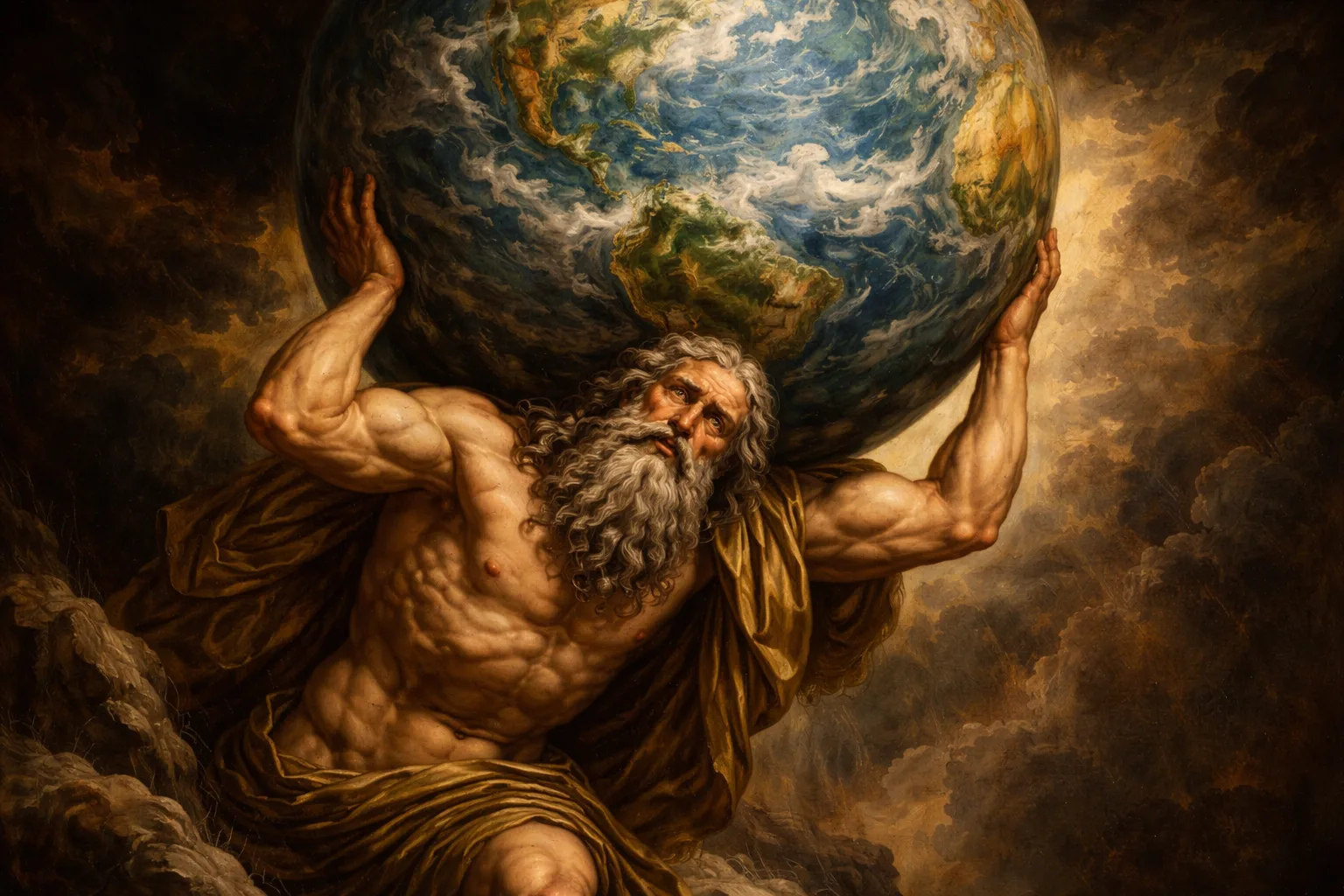
Atlas in Greek Mythology belongs to the most imposing forms of the ancient mythological world. He's not just a strong man. Titan Not just a picture of a man lifting unimaginable weight. It is a form of boundary, placed on the border between the divine order of the Titans and their new sovereignty Olympian gods, between Earth and Heaven, between myth, cosmology, art and later cultural memory. Its form is linked to the Zeus, the Titanomachy, Hercules, Peppers, the Pleiades and the very ancient conception of the structure of the world.
In modern imagination, Atlas is often portrayed as holding the Earth on his shoulders. Yet the ancient Greek tradition is clearer and more interesting: Atlas held up the sky, or more precisely the celestial vault, as punishment after the Titans were defeated by Zeus. This distinction is not a minor detail, but a key to understanding the myth.
Who was Atlas in Greek Mythology? The identity and role of Atlas
To answer the question «Who Atlas was?», first need to consider his position within the wider system of Greek mythology. Atlas was a second generation Titan, his son Japan and Klymeni or Asia, depending on tradition. It therefore belonged to the divine generation that precedes the definitive prevalence of Zeus and the Olympian gods. But his identity is not depleted in genealogy. Atlas is Titan associated with the support of heaven, with the western extremities of the world, with the garden of Esperides and with a series of important descendants associated with stars and seasons.
His mythological figure is formed mainly through his punishment. After TitanomachyZeus forced him to keep the celestial dome away from Earth. His sentence was not instantaneous, but lasting and secular. Atlas thus became a living proponent of the order of the world, a form eternally enduring the burden of divine decision.
Conclusion: Atlas in Greek Mythology was a Titan, son of Iapetus, father of important mythological figures, and above all the condemned bearer of the sky, a symbol of endurance, responsibility, and punished Titanic power.
The Position of Atlas Among the Titans
Titans of Greek mythology are the pre-alympian divine generation, children mainly of Heaven and Gaia. Among them stand out forms such as Cronus, - Rhea, Oceanus, - Themis, - Mnemosyne and IapetusAtlas, as the son of Iapetus, does not belong to the first but to the second generation of Titans, along with the brothers of Prometheus, Epithea and Menocius.
Atlas' position is special, because he does not appear merely as a relative of the old gods but as an active person of the conflict between Titans and Olympians. Tradition presents him to have stood with the Titan side, which explains his harsh post-war punishment. As opposed to Prometheus, who maintains a complex relationship with Jupiter and humans, Atlas is more tied to the image of resistance against new divine authority.
Conclusion: Atlas the Titan is not a marginal figure, but one of the most important representatives of the Titanic generation after its defeat, because his fate reflects the transition from the old cosmic order to the rule of Zeus.
Why Atlas Became One of the Most Famous Figures in Mythology
Atlas’ fame is due not only to his presence in ancient sources, but above all to the power of his image. A giant or Titan who eternally bears the weight of the sky is a figure easily recognizable, deeply symbolic, and artistically powerful. This image passed from ancient poetry into vase painting, from Roman sculpture into Renaissance art, and from geography into modern pop culture.
At the same time, his myth was associated with Hercules, one of the most popular heroes of Greek mythology. The Atlas and Hercules meeting in the feat of the Golden Apples of Esperides made its form even more known. His involvement with Pleiades, Hyades and Esperides also linked him to heaven, astronomy and seasonal changes.
Conclusion: Atlas became famous for combining secular punishment, heroic adventure, astronomical tradition and a powerful symbolism that remained alive for centuries.
The Origin and Family of Atlas
The Father Iapetus
Japanese is one of the first generation Titans, his son Uranus and Gaia. In his lineage Hesiod, Iapetus holds an important position because he is the father of four forms of special mythological significance: Atlas, Menoiti, Prometheus and Epimetheus. Through his sons, Japanese is associated with different aspects of divine and human fate: punishment, hubris, welfare, carelessness and the relationship of men with the gods.
Conclusion: Iapetus gives Atlas his Titanic ancestry and places him within a family that expresses some of the great conflicts of Greek mythology.
The Mother Clymene or Asia
In Hesiod, the mother of Atlas is mentioned the Cloister, one of the Oceanids. In other traditions Asia also appears Oceanidas, as the wife of Japetus and the mother of his children. This differentiation is not unusual in Greek mythology, where genealogies change according to local tradition, poet or the theological emphasis of each narrative.
The presence of an Oceanid as mother is significant, because it connects Atlas not only with Earth and Sky, but also with Oceanus, the ends of the world, and the western geographical imagination of the ancient Greeks.
Conclusion: whether as son of Clymene or Asia, Atlas is genealogically linked with primordial cosmic powers and the limits of the known world.
His Brothers: Prometheus, Epimetheus, Menoetius
Atlas's brothers brighten his own position better. THE Prometheus is the benefactor of men, the one who deceived Zeus in distributing the sacrifice and stole the fire for mortals' sake. The Epimetheus, on the other hand, is linked to the carelessness and acceptance of PandoraMenoitius is presented by Hesiod as abusive and violent, which is why he is thundered by Zeus and thrown down into Erebus.
Atlas stands among these figures as the one who suffers not a single thunderbolt, but an enduring condemnation. The family of Iapetus seems to summarize different versions of conflict with Zeus.
Conclusion: the brothers of Atlas show that his family is central to understanding divine authority, resistance, and punishment in Greek mythology.
The Family Tree of Atlas
His Daughters: Pleiades, Hyades, Hesperides
The Atlas genealogical tree is rich and complex. Atlas's most famous daughters are Pleiades, usually seven: Midwife, Electra, Taygetis, Alkyone, Kelaineau, Steropi and Meropi. Their mother is considered the Pleion, too. Ocean. The Pleiades became stars and gained special importance in ancient navigation and agricultural life.
Another group of daughters are the Hyades, associated with rain and star or constellation of the Hyades. In various traditions they are considered daughters of Atlas and Terrace or other Ocean. The Esperides, the nymphs of golden apples at the western ends of the world, are also associated in several traditions with Atlas, though elsewhere considered daughters of Nyx or other divine forms.
Conclusion: the daughters of Atlas reveal that his myth is not limited to his punishment, but extends into the sky, the stars, nature, and the mythical boundaries of the earth.
Other descendants
Beyond these well-known groups of daughters, Atlas is also connected with other figures. Calypso, the nymph who shelters Odysseus in the Odyssey, is called the daughter of Atlas by Homer. Maia, one of the Pleiades, bore Hermes to Zeus, one of the most important Olympian gods. Through this genealogy, Atlas becomes the grandfather of Hermes.
Conclusion: the descendants of Atlas connect him both with heroic and divine narratives and with the astronomical imagination of the ancient Greeks.
Atlas and the Titanomachy
The Great Conflict Between Titans and Olympian Gods
The Titanomachy was the great war between the Titans, led by Cronus, and the younger gods, led by Zeus. This conflict was not simply a family quarrel, but a cosmic struggle for sovereignty over the universe. The Olympians, with the help of the Cyclopes and the Hundred-Handed Ones, eventually prevailed.
Conclusion: Titanomachy explains why Atlas' form is linked to the fall of the old divine order.
The role of Atlas in the war
The ancient sources do not always provide a detailed account of Atlas’ military role. However, the punishment imposed on him shows that he was regarded as an important opponent of Zeus. In later narratives he is often presented as a leading, or at least powerful, figure in the camp of the Titans.
The logic of the mythological narrative is clear: the greater the guilt or threat, the heavier the penalty. Atlas is not merely imprisoned in Tartarus, but assigned to an eternal cosmic service.
Conclusion: Atlas’ role in the Titanomachy was significant enough to bring upon him one of the harshest and most symbolic punishments imposed by Zeus.
The defeat of Titans
After Zeus’ victory, most of the Titans were cast into Tartarus. The new order was established on Olympus, and the world was organized under the rule of the Olympian gods. Atlas differs from many other Titans because his punishment is not imprisonment underground, but exposure at the edges of the world.
Conclusion: the defeat of the Titans determined the fate of Atlas and transformed him from a warrior of the old generation into the eternal support of the sky.
The Punishment of Atlas
Why did Zeus punish him?
Zeus punished Atlas because he had sided with the Titans in the great struggle for dominion over the world. Within the logic of the myth, the punishment was not arbitrary, but an act of enforcing the new cosmic order. Zeus had to show that resistance to his divine kingship had consequences.
Conclusion: the punishment of Atlas was the result of his participation in the Titanic resistance against Zeus.
What Exactly Did Atlas Hold?
Ancient sources present Atlas holding the sky or pillars separating Earth from Heaven. Hesiod describes him standing at the ends of the earth, near Peppers, holding the sky with his head and hands. Homer speaks of long columns that keep the earth and heaven apart.
Conclusion: Atlas held up the celestial vault, not the Earth.
The Difference Between Sky and Earth
This distinction matters because in ancient cosmology Uranus and Gaia are separate primordial entities. Uranus is not a planet, but a vault or divine region above the Earth. The Earth lies below, inhabited by gods, humans, and creatures, while the sky is a higher cosmic level. Atlas does not carry a spherical world as in later images, but maintains the separation between two cosmic regions.
Conclusion: ancient tradition does not identify the burden of Atlas with the Earth, but with the preservation of cosmic order between Earth and Sky.
The Symbolism of the Punishment
The punishment of Atlas symbolizes power brought under control, responsibility turned into burden, and the eternal consequence of conflict with divine authority. Atlas does not die, but endures. He does not disappear, but remains visible as a sign of Zeus’ victory.
Conclusion: the punishment of Atlas is at once a penalty, a cosmic function, and a powerful symbol of endurance.
Did Atlas Hold the Earth or the Sky?
The Modern Misconception
The modern image of Atlas holding the Earth comes mainly from later artistic and publishing traditions. When people see a sphere on his shoulders, they interpret it as the planet Earth. Yet in ancient representations, the sphere may be the celestial vault or celestial sphere, that is, the region of the stars.
Conclusion: the idea that Atlas held the Earth is a later misconception.
What ancient sources say
Hesiod states that Atlas holds up the broad sky. Homer connects him with pillars that separate earth and sky. Apollodorus, in the myth of Heracles, presents the hero as temporarily taking the weight of the sky upon his shoulders so that Atlas can fetch the apples of the Hesperides.
Conclusion: the main ancient testimonies agree that Atlas held up the sky.
How the Image of Atlas Holding the World Was Created
The confusion was strengthened by the development of geography and cartography. The word “atlas” became associated with collections of maps, while the depiction of a strong man holding a sphere was easily understood as “the man who carries the world.” In addition, the everyday phrase “the weight of the world” reinforced the metaphorical identification of the sky with the Earth.
Conclusion: the image of Atlas holding the world emerged from the union of ancient myth, heavenly sphere, cartography and younger symbolic interpretation.
Atlas and Hercules
The Golden Apples of the Hesperides
One of his feats Hercules was to bring the Golden Apples of Esperides. These apples were in a garden at the western ends of the world and were guarded by the Esperides and, in many traditions, by dragon Ladon. The mission was difficult not only because the place was far away, but also because it belonged to an area divine and borderline.
Conclusion: the Golden Apples were a trial that required not only strength, but also knowledge, a journey to the limits of the world, and intelligence.
The Meeting of Atlas and Heracles
In the version preserved by Apollodorus, Heracles meets Atlas and asks him to fetch the apples, since as father or relative of the Hesperides he had access to the garden. To free him temporarily, Heracles takes the sky upon his own shoulders. This scene is important because the mortal hero assumes, even if only for a short time, a Titanic burden.
Conclusion: the myth of Atlas and Heracles presents the meeting of two figures of superhuman strength, but also the contrast between physical endurance and intelligence.
The Trick of Hercules
When Atlas returns with the apples, he does not want to take back the burden of the sky. He proposes to carry the apples himself to Eurystheus, leaving Heracles in his place. Heracles realizes the danger and pretends to agree, asking only that Atlas hold the sky for a moment so that he can place a cushion or support on his shoulders. As soon as Atlas takes the burden back, Heracles takes the apples and leaves.
Conclusion: Heracles wins not through brute force, but through cleverness, avoiding the inheritance of Atlas’ eternal punishment.
The Meaning of the Myth
The story shows that even the greatest strength requires prudence. Atlas wants to be freed from his burden, while Heracles understands that accepting a cosmic load may become a trap. The myth connects heroic action with limits: the hero may touch the Titanic, but must not become trapped in it.
Conclusion: the myth of Heracles and Atlas teaches that true heroic success combines strength, wisdom, and the ability to avoid hubris.
The Daughters of Atlas
The Pleiades
The Pleiades are among the most famous daughters of Atlas. Maia, Electra, Taygete, Alcyone, Celaeno, Sterope, and Merope were connected with heroes, gods, and the genealogies of important peoples. Maia gave birth to Hermes, Electra was associated with the lineage of Troy, while other Pleiades were linked with royal houses and local traditions.
Conclusion: the Pleiades connect Atlas with astronomy, divine genealogy, and heroic tradition.
The Hyades
The Hyades are connected with rain and the seasonal observation of the sky. Their name was already associated in antiquity with hyetos, meaning rain, although etymologies in ancient mythology often function poetically. As daughters of Atlas, the Hyades strengthen his connection with the celestial realm and natural phenomena.
Conclusion: the Hyades show that the family of Atlas functions as a bridge between myth and the observation of nature.
The Hesperides
The Hesperides are nymphs of the evening, western realm. They guard the Golden Apples, a gift associated with the marriage of Zeus and Hera. Traditions about their origin vary, but their connection with Atlas is strong in several narratives, especially because of his proximity to their garden.
Conclusion: the Hesperides connect Atlas with the western limits of the world, immortality, divine guardianship, and the labor of Heracles.
Their Role in Mythology and Connection with Astronomy
The daughters of Atlas are not merely family figures. The Pleiades and the Hyades were visible star clusters, important for ancient timekeeping, agriculture, and navigation. Their rising and setting in the sky were connected with seasonal tasks and weather changes.
Conclusion: through his daughters, Atlas becomes the mythological father of celestial markers that helped humans orient themselves in time and space.
Atlas in the Ancient Sources
Hesiod
In the Theogony, Hesiod presents Atlas as the son of Iapetus and Clymene and brother of Menoetius, Prometheus, and Epimetheus. He places him at the ends of the earth, near the Hesperides, holding up the sky with his head and hands. This testimony is fundamental because it defines the classic image of his punishment.
Conclusion: Hesiod is the main source for Atlas as the Titan who holds up the sky.
Apollodorus
The Library of Apollodorus systematically preserves many mythological traditions. In the labor of the Hesperides, Apollodorus presents the meeting of Heracles with Atlas and the trick by which the hero avoids remaining forever beneath the weight of the sky.
Conclusion: Apollodorus is a key source for the myth Atlas and Hercules.
Homer
In «Odyssey», Atlas appears as her father Welcome And as a form that knows the depths of the sea and holds long columns that separate earth and heaven. The Homeric image is more cosmological and mysterious, linking Atlas to the sea, boundaries and structures of the world.
Conclusion: Homer offers one of the oldest and most poetic testimonies for Atlas as guardian of secular boundaries.
Other ancient writers
Later Greek and Roman writers, such as Diodorus Siculus, Pausanias, Ovid, and others, enriched or reworked the myth. In some traditions, Atlas is connected with northwestern Africa, the Atlas Mountains, and the Atlantic region. Ovid, in Roman poetic tradition, also narrates the transformation of Atlas into a mountain after his encounter with Perseus, although this version belongs to later literary elaboration.
Conclusion: later sources expanded the geographical and artistic dimension of Atlas without overturning the basic core of the ancient Greek tradition.
Brief summary of the most important testimonies
A full examination of the sources reveals a stable core and several variations. The stable core is that Atlas belongs to the Titanic generation, is connected with the ends of the world, and holds up the sky or the pillars that separate sky and earth. The variations concern his mother, some of his daughters, his geographical location, and episodes from later tradition.
Conclusion: the ancient sources present a coherent mythological core, around which rich local, poetic, and artistic versions developed.
Atlas in Art and Culture
Ancient Greek Art
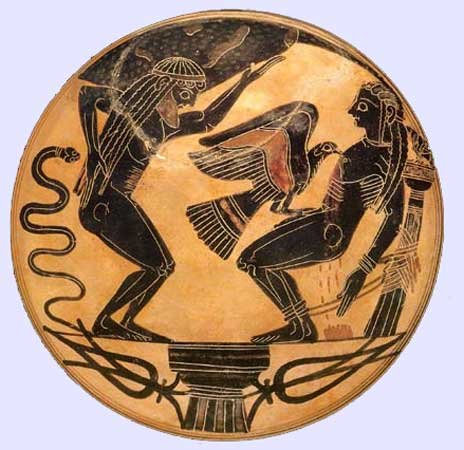
In ancient Greek art, Atlas appears mainly in scenes related to Heracles and the Apples of the Hesperides. Vase painting and sculpture depict him as a powerful male figure carrying a celestial burden. The tension of the body, the bending of the shoulders, and the stability of the posture are key artistic elements.
Conclusion: Greek art emphasized physical endurance and the mythological moment of contact with Heracles.
Roman representations
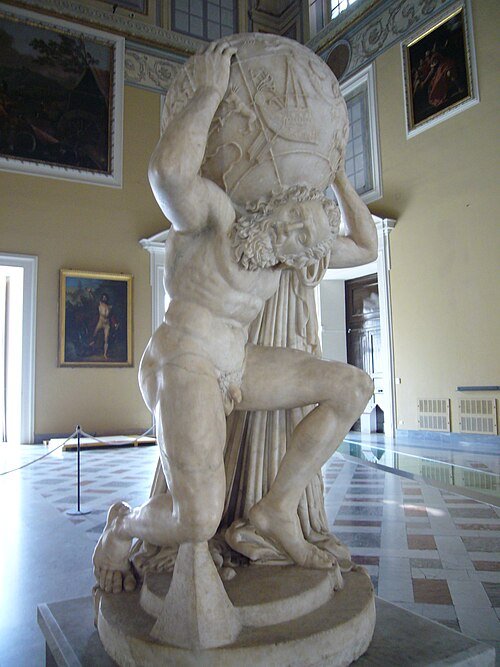
In Roman art, Atlas acquired an even more monumental form. The famous Farnese Atlas shows the Titan holding a celestial sphere engraved with astronomical elements. This image deeply influenced later European imagination.
Conclusion: Roman representations decisively contributed to the spread of Atlas' image as a heavenly sphere carrier.
The Celestial Vault
The celestial vault held by Atlas is not a simple decorative sphere. It represents the ancient understanding of the sky as an ordered space in which stars and constellations move. Its depiction as a sphere helped artists translate a cosmic burden into visible form.
Conclusion: the celestial vault explains why the figure of Atlas became a symbol of cosmic support.
Origin of the word «Atlas»
The name Atlas was connected in antiquity with the mythical Titan and later with geographical terms, such as the Atlas Mountains and the Atlantic Ocean. The exact etymology of the name has been debated, but its cultural influence is beyond doubt.
Conclusion: the word “Atlas” began as a mythological name and became a term with geographical, astronomical, and symbolic uses.
Maps and geography
The use of the word “atlas” for a collection of maps became established mainly in early modern Europe, especially after the publication of cartographic works that made use of the mythological image of Atlas. The connection is understandable: just as the Titan holds up the celestial vault, so a map symbolically “holds” knowledge of the world.
Conclusion: the geographical use of the term derives from the transfer of mythological support to cartographic knowledge.
Modern literature and pop culture
In modern literature, cinema, comics, and games, Atlas often appears as a symbol of Titanic strength or unbearable responsibility. Although many modern versions simplify the myth, they preserve its basic symbolism: a figure who carries something greater than himself.
Conclusion: pop culture retained the recognition of Atlas, even often with a simplified image.
The Symbolism of Atlas
Liability
Atlas symbolizes responsibility when it becomes an unavoidable burden. He no longer chooses his role; he suffers it. His posture reminds us that responsibility may be the consequence of actions, decisions, or defeat.
Conclusion: Atlas is a timeless symbol of heavy responsibility.
Strength
His eternal attitude under heaven makes him a model of endurance. He doesn't win, but he insists. It doesn't move, but it stays.
Conclusion: Atlas' endurance is endurance within time, not instant power demonstration.
Power
The power of Atlas is titanic, but not free. He's in custody. This makes his symbolism more complex than mere physical power.
Conclusion: Atlas symbolizes power that has been submitted to a superior secular class.
Patience
Atlas' patience is not a calm virtue, but a forced duration. The myth shows patience as survival in a situation without an easy solution.
Conclusion: Atlas expresses patience as a long and painful persistence.
The weight of the world
Although Atlas held up the sky and not the Earth, the phrase “the weight of the world” accurately conveys his metaphorical meaning. A person who feels burdened by responsibilities beyond their strength recognizes in Atlas a mythological image of their own experience.
Conclusion: Atlas became a global symbol because his mythical burden expresses a common human sense.
Interesting Facts about the Atlas
1. Atlas did not hold the Earth in ancient Greek sources, but the sky or columns separating earth and heaven.
2. In Hesiod he stands near Esperides, to the ends of the earth, which connects him to the evening, western space.
3. Homer presents him as the father of Calypso, the nymph who kept Ulysses on her island.
4. Through Maia's daughter, Atlas is Mercury's grandfather.
5. The Pleiades, daughters of Atlas, is a real star cluster visible to the naked eye.
6. The Hyades were associated with the rain and seasonal observation of the sky.
7. Hesperides do not always have the same genealogy· in some sources are connected to Atlas, in others to Night.
8. Hercules temporarily kept the sky in place of Atlas, according to the legend of the Golden Apples.
9. The word «atlas» for collecting maps is a newer use that uses Titan's mythological image.
10. Farnesios Atlas is one of the most important ancient representations of a celestial sphere in art.
Frequently Asked Questions about Atlas
Who was Atlas?
To understand who Atlas was, one must consider his genealogy, the Titanomachy, and his punishment. He was the son of Iapetus, brother of Prometheus, Epimetheus, and Menoetius, and father of important mythological figures such as the Pleiades. His most characteristic feature is that he was condemned by Zeus to hold up the sky.
Conclusion: Atlas was Titan of Greek mythology and eternal carrier of the heavenly dome.
Was he a god or a Titan?
Titans are divine beings earlier than Olympians, but are a special category within divine genealogy. Atlas is not an Olympian god like Zeus or Apollo, but belongs to the Titanic generation.
Conclusion: Atlas was Titan, or divine form of the pre-lympian generation.
Why was he holding the sky?
Atlas fought or was drafted with the Titans against Zeus. After the Olympian victory, Zeus imposed penalties on his opponents. The Atlas was given the terrible punishment to keep the sky to the ends of the world.
Conclusion: he held the sky as punishment for his participation in the Titan resistance.
Was he holding the Earth or the sky?
Ancient sources speak of heaven, heavenly dome or columns separating earth and heaven. His image of holding the Earth is later misunderstanding, enhanced by the use of a heavenly sphere in art and by the connection of his name with maps.
Conclusion: Atlas held the sky, not the Earth.
Who were his children?
Traditions refer as his children the Pleiades, the Hyades and in several versions the Esperides. Also, Calypso is characterized by his Homer daughter Atlas. Through the midwife it is also connected to Mercury.
Conclusion: the children of Atlas include mainly important nymphs and stellar forms of Greek mythology.
What was his relationship with Hercules?
Hercules met Atlas in the feat of the Golden Apples of Esperides. Atlas brought the apples while Hercules temporarily kept the sky. When Atlas tried to avoid returning to his weight, Hercules tricked him with a trick.
Conclusion: their relationship is epic and is linked to one of Hercules' most important feats.
What does Atlas symbolize?
His myth combines punishment, endurance, strength and responsibility. Because it stands eternally under a cosmic weight, its form became an ideal symbol for the feeling that one raises burdens disproportionately with its nature.
Conclusion: Atlas symbolizes the endurance of responsibility and fate.
Conclusion
Atlas in Greek Mythology is much more than a famous image of power. He is Titan of the generation of Iapetus, brother of Prometheus, father of the Pleiades and other important figures, opponent of the Olympian class and eternal carrier of the heavenly dome. The punishment of Atlas by Zeus after Titan fighting reflects the transition from the old Titanic power to the new sovereignty of the Olympian gods.
His connection with Hercules, Esperides and Golden Apples adds to his myth a heroic dimension, while his daughters, Pleiades and Hyades, join him with heaven, astronomy and nature observation. Ancient sources, from Hesiod and Homer to Apollodorus, agree to the core core: Atlas held the sky, not the Earth.
His timeless recognition is due precisely to this unique union of myth and symbol. Atlas expresses the strength he endures, the responsibility he weighs, the patience that lasts and the eternal weight of a secular class. This is why it remains one of the most powerful and recognizable forms of Greek mythology and world culture.