
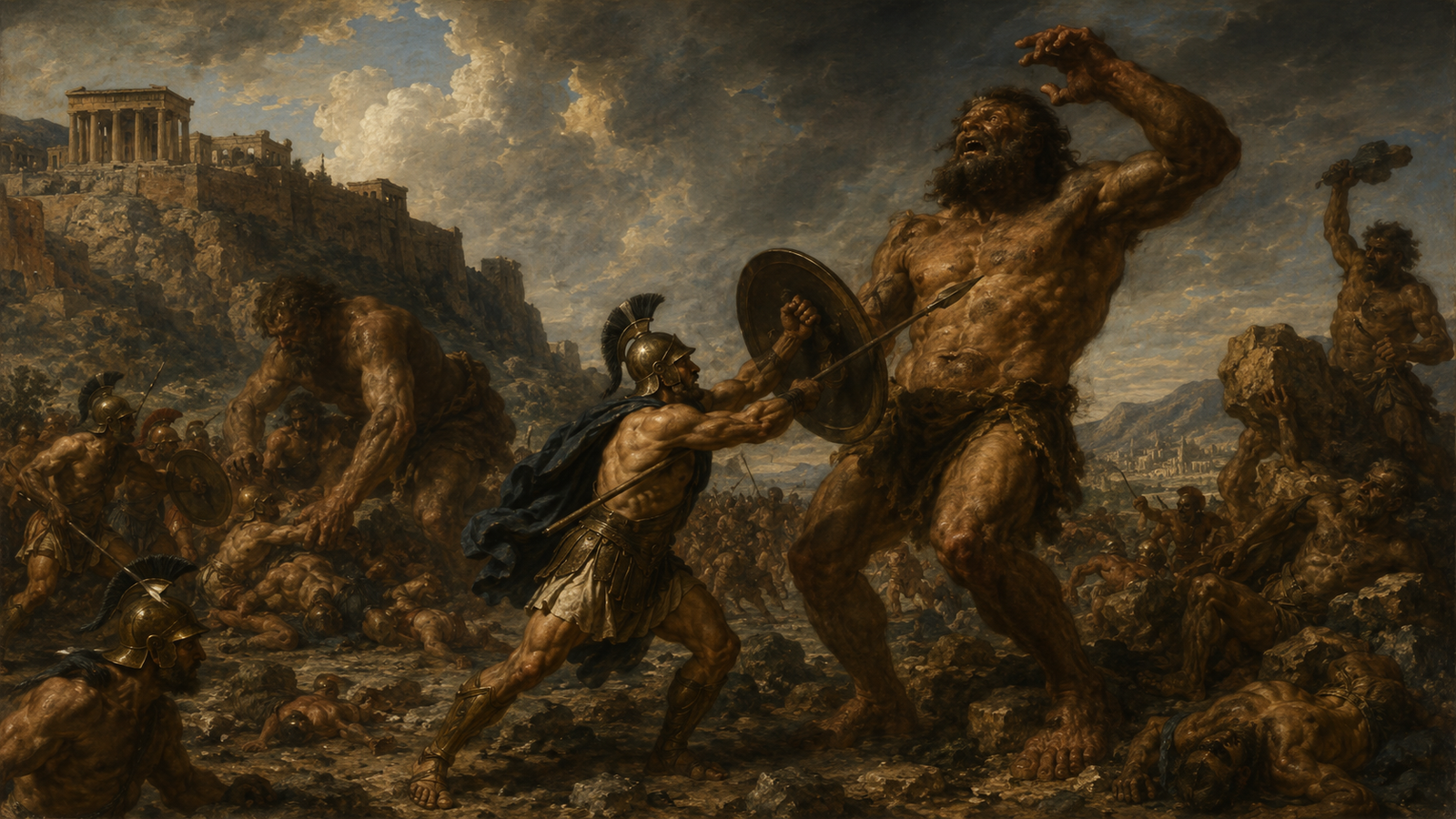
What's a giant fight?
- Gigantomachy is one of its most impressive and symbolically charged battles Greek mythology. This is the conflict between Olympian gods and Giants, a race of supernatural beings associated with the earth, primitive power and threat of disorder. As opposed to Titanomachy, where the gods fight the Titans for the domination of the world, the Giant Battle is presented as the next great contest: the final confirmation of the divine order against the ignorant forces of chaos.
In ancient Greek thought, myth does not only function as an exciting narrative. It reflects a deeper idea: that the world is gaining stability when it is imposed on the order on the uncontrolled, earthly or pre-cultural forces. That is why the Giant Battle has been alive for centuries in the art, literature and collective memory of the Greeks.
Mythological Framework of Giant Fighting
The Origins of Giants
The most famous ancient source for the birth of the Giants is Hesiod, Theogony. There, Giants are associated with the earth and old secular violence: born of his blood Uranus who fell to Earth after his castration by Saturn. Other beings associated with that primordial episode, such as Furies and Melies, appear in the same tradition.
However, Greek mythology is never monophonic. In later or parallel traditions the Giants are simply described as powerful, giant beings, often with reptilian characteristics, residing near the earth or in steep areas. Their form varies depending on the season and the artistic environment.
Giant fighting and Titanic fighting: what's the difference?
The confusion between Giantfighting and Titan fighting is common, but these are two different mythological episodes.
- Titanomachy: The battle of the Olympians with the Titans, which leads to the prevalence of Zeus and his brothers.
- Gigantomachy: The next major conflict, when Giants attempt to overthrow the Olympians.
In simple terms, Titan fighting is about the transition from Saturn's primary rule to the new divine generation, while Giant fighting is about consolidating this new order against an even more «Earth» And a violent threat.
The main protagonists
Giants don't have a single, fully stable list in all sources. But art and literature mention certain names that often come back:
- Alcyone: One of the most famous Giants, connected to the battle in Thrace.
- Porphyria: Powerful Giant who appears in several traditions as one of the most dangerous opponents of the gods.
- Enceladus: Giant later associated with seismic phenomena.
- Polybot: It connects to Dodecanese and especially Kos.
- Mimas, Nightmare, Pallas: Names encountered in various traditions and visual renderings.
On the part of the gods, sovereigns are Zeus, - Athena, Apollo, Poseidon, Dionysus, Ares, - Artemis, - Aphrodite, - Hecate More Olympians. It is particularly important that Hercules, who is not a god but a mortal hero of divine descent and plays a decisive role in the victory of the gods, according to prophecy.
The evolution of myth
The prophecy and role of Hercules
One of the basic patterns of Giant Fighting is that Giants cannot be defeated only by the gods. Tradition states that it had been foretold that to overcome, a mortal hero needed to participate. Thus, the Hercules, already a symbol of bravery and superhuman power, becomes Jupiter's necessary partner.
This element is of particular importance: it shows the connection between divine and human. Hercules acts as a mediator between worlds, while the mythical victory acquires a character of collective confrontation, not only divine.
Indicative duels and incidents
Giant combat, like many myths of ancient times, is not a single, detailed account of events. Instead, it is preserved through fragmentary traditions, epic references and artistic performances.
Some of the most famous episodes include:
- His victory Poseidon on Polybotis, with the help of Nisyros Island, which tradition often connects to the astonishment or sinking of the Giant.
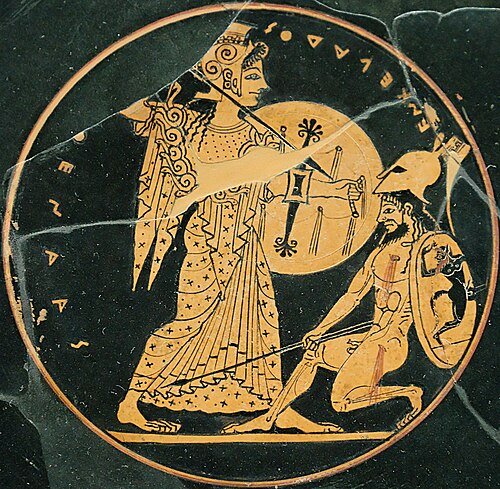
- Its participation Athena, which appears as a strategic form, giving the battle a dimension of wisdom and organized power.
- The action of Apollo, killing giant with his arrows, symbolizing purity, measure and preventing abusive violence.
- His death Enceladu, which, in later tradition, is associated with seismic vibrations, as often happens in myths where a cosmic being «buried» Under the earth.
- The Porphyrion, which is associated with one of the most dramatic and iconic encounters of mythology.
Details vary, but the general picture is clear: Olympians are imposed and secular order is restored.
Symbolism and cultural significance of Giant Fighting
Order versus chaos
The Giant Battle acts as an archetype of the battle between order and chaos. Giants are not just big in size· represent the violent power of nature, the uncontrolled, the old and the threatening. The Olympians, on the contrary, represent the organized, hierarchical and civilized world.
This contrast is very characteristic of ancient Greek thought. The world is not quite harmonious. It takes struggle, measure and divine legitimacy to stay firm. That’s why Giant Fighting is often read as a myth of establishing order.
Political and cultural dimension
The Giant Fight was not only left at the level of the narrative. It was also used symbolically, especially in periods where Greek cities or Hellenistic kingdoms wanted to declare power, legitimacy and cultural supremacy.
The victory of the gods against the Giants could serve as an allegory:
- for the victory of culture over barbarity,
- on the prevalence of legal power over mutiny,
- to defend secular and social order.
In this context, Giantfighting is also of particular importance as a cultural tool of antiquity.
The Giant Battle in Ancient Sources
Hesiod and early tradition
- Hesiod is one of the most important poets for understanding the cosmogony and theogeny of the Greek world. The Theogony It forms a strong framework for the birth of divine generations and the first secular conflicts. Although it does not extensively recount the Giant Battle as we will later know it from other sources and art, it offers the necessary mythological background.
Apollodorus and the systemization of myth
It is important that the Library of Apollodorus, which gathers and organizes many myths of Greek tradition. There the Giant Battle is presented with greater narrative completeness and the need for Hercules' participation is described. Apollodorus helps today's reader understand how the «classic» form of myth.
Pausanias and local traditions
- Pausanias, in his work Greece Tour, records many local traditions and representations. For the study of Giant Battle, it is of particular value because it shows us how ancient Greeks saw the myth not as isolated narrative, but as a living element of worship, art and local memory.
The Giant Fight in Literature and Art
Angiography and visual tradition
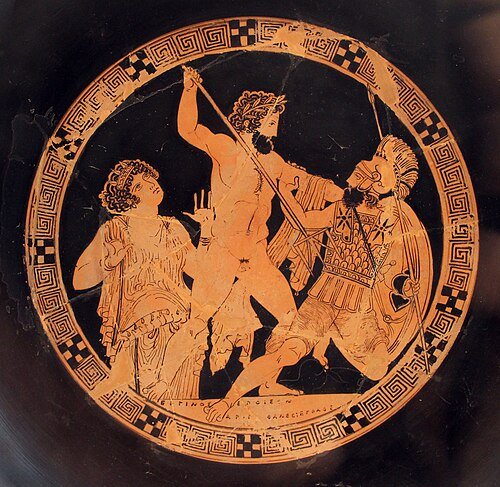
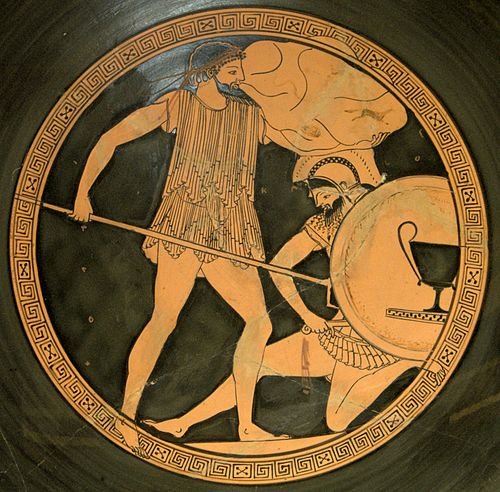
Giant fighting was an extremely popular theme in ancient Greek art. In angiography there are often scenes of gods fighting against large opponents, with intense movement and dramatic composition. Giants are often portrayed with snake legs, characteristic that enhances the feeling that they belong to a more ancient, ethic and dangerous level of existence.
The altar of Pergamum
The most famous monumental representation of Giant Battle is undoubtedly Great altar of Pergamum (2nd century BC). There, the battle takes on colossal dimensions and becomes almost a political manifesto of the Hellenistic era. The gods, with intense drama and movement, defeat the Giants in a composition combining power, aesthetic and ideological message.
The choice of the subject was not accidental. Pergamos, as an important center of the Hellenistic world, wanted to highlight its prestige through a myth where legitimacy and divine order triumph.
The Giant Fight in the Parthenon and Athenian Art
In classical Athens, Giantfighting was strongly associated with the identity of the city. The Parthenon metopes and other monuments use mythological conflicts, including the Giant Battle, to project the greatness of the city and its institutions.
In Athenian ideology, the myths of victory over excessive forces function as a reflection of the city itself: Athens is presented as a carrier of measure, logic and culture.
The Giant Fight in Ancient Greek History
From myth to historical self-consciousness
Although the Giant Battle belongs to mythology, its influence on ancient Greek history It's real. Cities-states, rulers and artistic centers of Greece and the Hellenistic world used the myth to express political power, historical continuity and cultural confidence.
The myth functioned as a language of power. When a city pretended to defeat the Giants, she was actually talking about her own victory over chaos, war threat or decline.
Hellenistic period and monumentality
In the Hellenistic era, monumental art especially loves the scenes of struggle and exaggeration. Giant combat, with its theatrical dynamism, offers the ideal field for artistic promotion. The human body, tension, movement and transcendence are attributed in a way that impresses even today.
That is why the subject remains so powerful in art history: it combines myth, politics and aesthetics in a single image of secular struggle.
Symbols Surviving to date
Giant combat is not just an ancient account. It is a timeless symbolism for the struggle between:
- in measure and hybrid,
- order and destabilisation,
- culture and raw power,
- institutional legitimacy and destructive arrogance.
Even in modern reading, the myth speaks of how societies try to define their boundaries against forces that transcend them. This is why the Giant combat in Greek mythology remains so topical as a symbolic figure.
Frequently Asked Questions About Giant Fighting
What does the word mean? «Giant fight»?
The word literally means «Battle of the Giants». In mythological use it refers to the conflict of the Giants with the Olympian gods.
What's the difference between Giant Fighting and Titanic Fighting?
Titan fighting is the battle of the gods with the Titans, while Giant fighting is the later conflict with the Giants. These are two different, though relative, episodes of cosmogenic mythology.
Who won the Giant Battle?
Winners are the Olympian gods, with the decisive contribution of Zeus and Hercules. Other gods, such as Athena, Poseidon and Apollo, participate in the individual traditions.
There was only one myth about Giant Fight?
Nope. Greek mythology has many variations. Other sources emphasize the birth of Giants, others in their names and duels, while art often adapts the subject to the needs of the time.
Why does Giant Fight appear so often in art?
Because it offers a strong visual and ideological symbol. The victory of the gods over the Giants expresses the prevalence of order, legitimacy and cultural superiority.
What is the most famous ancient representation of Giant Fight?
The most famous monumental cycle is Temple of Pergamum, and Parthenon includes related mythological scenes associated with the same ideological context.
Conclusion: why does Giant Fighting remain so important?
- Gigantomachy is one of the most powerful myths of ancient Greek tradition, not only because it tells an impressive battle, but because it condenses fundamental ideas of Greek thought: the conflict between order and chaos, the need for measure, the victory of legitimacy and the constant effort of the world to remain harmonious.
From Hesiod and Apollodorus until Pausania, from angiography to Temple of Pergamum, the Giant Battle crossed centuries of history, art and ideology. Therefore, today it is still considered one of its most important chapters Greek mythology: a myth that not only describes a battle, but the very struggle for the prevalence of secular and cultural order.