
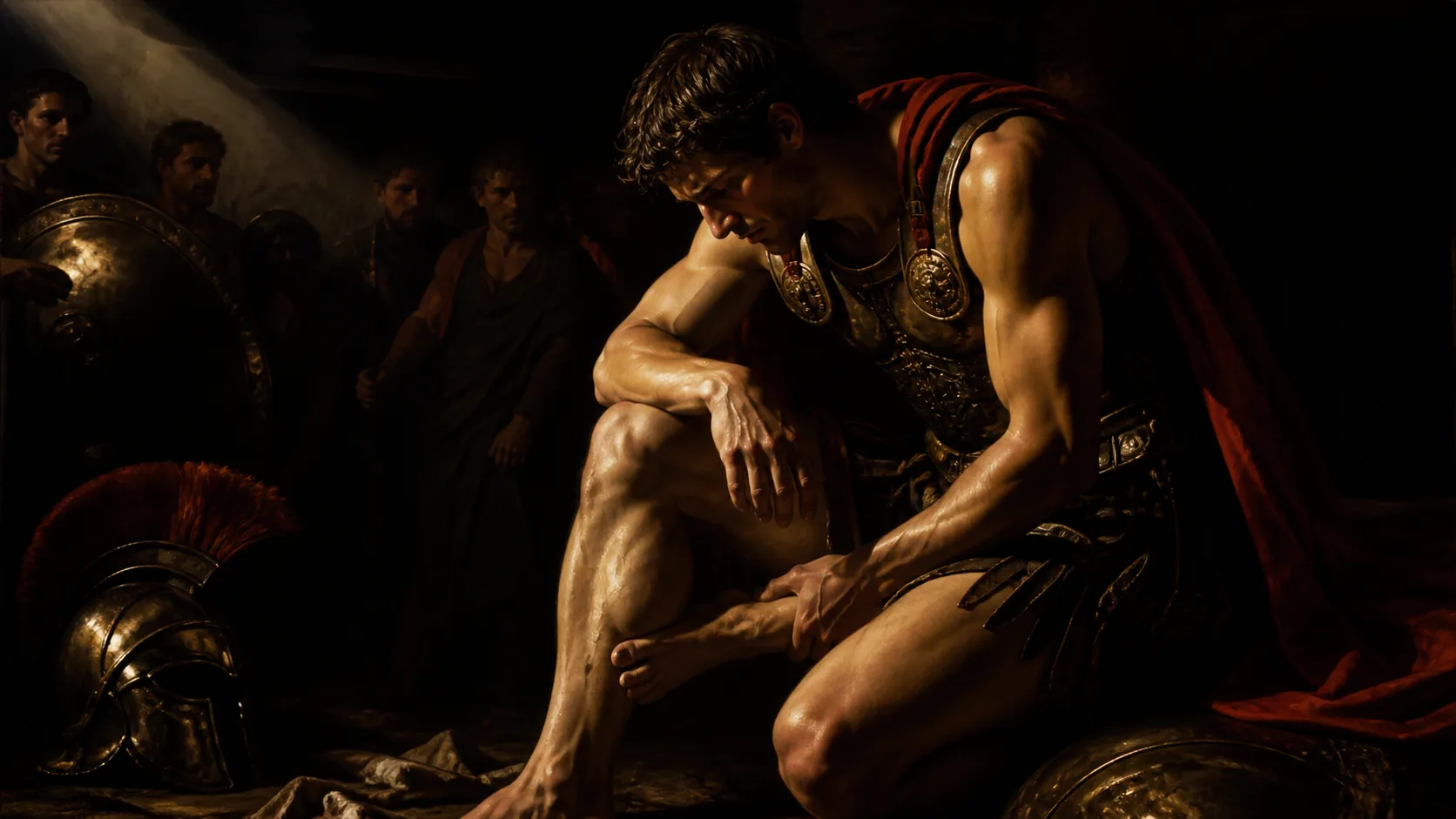
The myth of Achilles heel explains how Achilles, almost invulnerable from baptism at Styx, was left vulnerable to heel and killed by arrow in Troy. The text points out that this particular detail was formed mainly in later sources, not in Homer.
At the same time, it shows how history became a timeless metaphor for every hidden weakness within great power. It connects the myth with the mortality, irony of the protection of Thetis and the modern use of the term in anatomy and medicine.
- Achilles is the invincible warrior of Greek mythology — The fastest, the bravest, the most awesome on the battlefield. Yet, this almost immortal hero fell dead from a bow that struck him in the heel. How does the body of a demigod have such a great weakness? And what does that tell us about our relationship with mortality, perfection, and reckless human nature?
The birth of a hero — And the sleep of fate
According to legend, Achilles was the son of mortal Peleas and the goddess Thetis, a spindle with special power. Immediately after his birth, Thetis decided to make her son invulnerable — And no one could resist that maternal ambition. So he plunged him into the Styx, his sacred river Underworld, holding him by the heel.
The result was a body almost completely protected — Only at this one point that didn't touch the water. The heel was left exposed, vulnerable, hidden weakness within the enormous power. It was a small price for a huge gift. — Or so it seemed.
«The heel position was not accidental. It was the point from which Achilles hung between God and man.»
— Mythological analysis
The battle in Troy and the fatal arrow
The Trojan War was the theater where Achilles showed all his glory. He was the one who killed Hector, Troy's greatest warrior, avenged the death of his friend Patrocle. He seemed invincible. However, fate had already been determined: Achilles knew he would die young in Troy.
His death came from the arrow of Paris — of the Trojan prince who was not known for his war valor. Apollo, a god protecting Troy, guided the arrow into the unique vulnerable area of his body. It was like the universe had found the only way to defeat the invincible.
The historical misunderstanding — What Homer really says
Here lies an interesting detail that is often overlooked: Homer, in Iliad, does not mention the heel anywhere as Achilles' weak point. The story of baptism at Styx appears in later sources — mainly in the poetry of Statius (1st century AD) in the work «Apples»Homer merely mentions Achilles' death by arrow — without explaining why this point was vulnerable.
This means that the myth evolved over the centuries, enriched and became more definitive. The need for people to explain how the greatest warrior could die from an arrow led to the creation of a much smarter narrative: if he was almost immortal, then his vulnerability was necessarily hidden in some secret place.
The metaphor that conquered the world
The phrase «Achilles heel» Today it is not just about anatomy — refers to any critical weakness of any otherwise possible human, system or organism. A country with a strong economy but dependent on foreign energy sources? Achilles heel. A leader with awesome abilities but a weakness to trust? Achilles heel.
The power of metaphor lies in that it immediately carries an entire story: the coexistence of power and vulnerability, the fate that is not avoided, the hidden point that awaits its moment. No one is perfectly invincible.
What this myth tells us about people
In its deeper reading, the myth of Achilles heel is a lesson to mortality. There is no human existence — As strong as it is — without any inherent weakness. Thetis tried to resist this truth and failed. Baptism in the Styx was not redemption — It was just a postponement.
There is also an intense irony: the same point Mother held to plunge the son into the water of immortality, what symbolizes her care and love, eventually became the cause of his death. Mother protection hid the seed of tragedy within it.
«Weakness is not contrary to power — It's part of her. There is no complete power without a point of vulnerability.»
Achilles heel in anatomy
It is no coincidence that the strongest tendon of the human body was named after the myth. Achilles' tendon — The largest tendon in our body, linking the gastrocnemium to the heel — It was named this in the 18th century. Ironically, this tendon is simultaneously one of the strongest and most prone to ruptured athletes.
Achille tendon rupture is one of the most common sports injuries — Especially in sprints and sudden jumps. Doctors and therapists use expression «Achilles heel» In a literal way, without perhaps realizing that they refer to a 3,000 - year - old myth.
Conclusion: The eternal relationship of power and weakness
The «Achilles heel» It's not just a story about a hero who died of an arrow. It is a myth that endures time because it touches something deeply true: no one can completely escape his vulnerability. Power and weakness coexist — and the illusion of perfect armor is often the most dangerous trap.
That is why the myth remains alive. Every time we hear the phrase in a report, political analysis or medical diagnosis, we recall this ancient truth. Achilles lived 3,000 years not only as a hero — but also as a reminder that even the strongest have their weakness.
Read more