
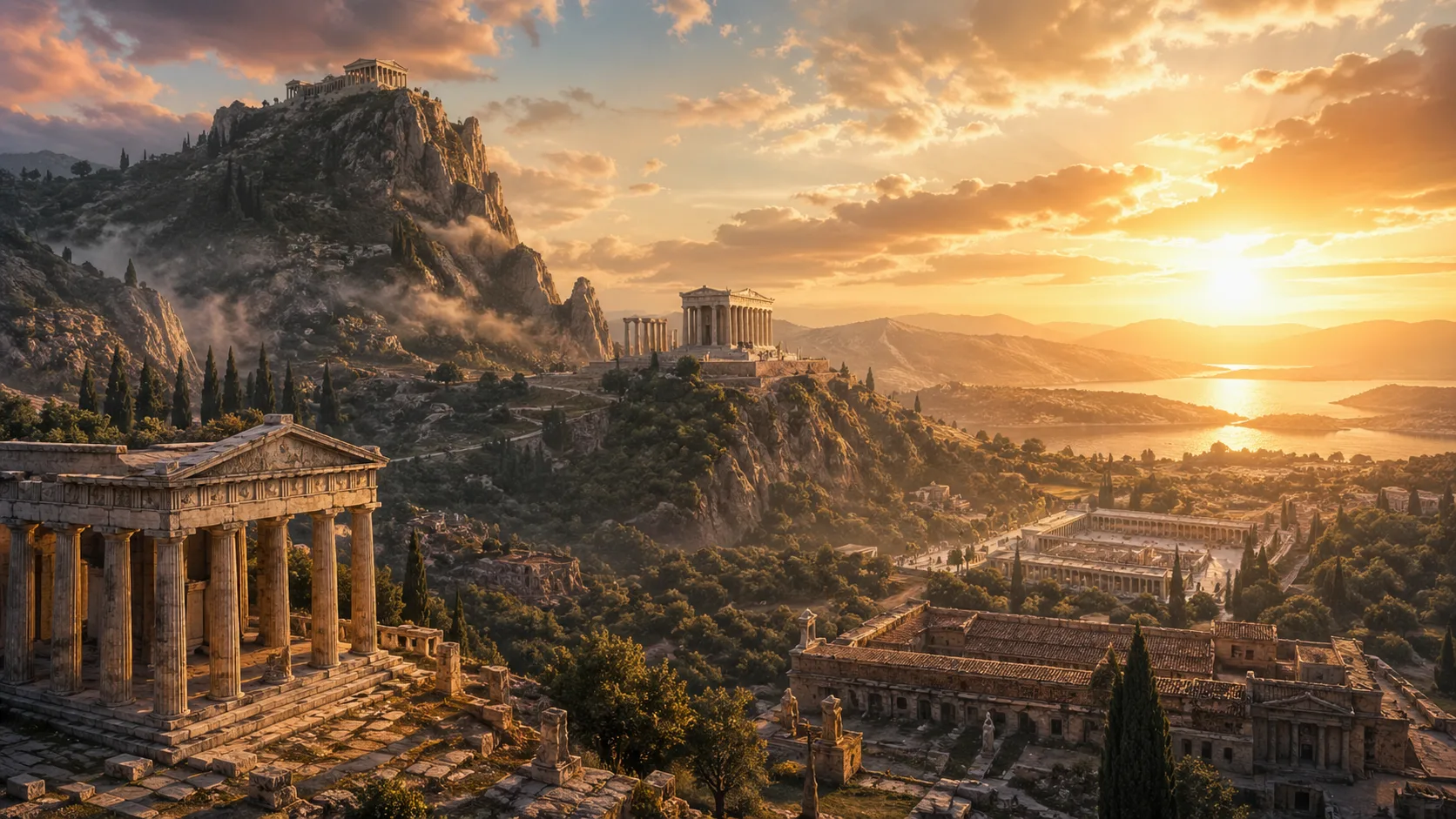
Religion and sacred places of ancient Greece. From Olympus to them Delphi — a world of gods, myths and sacred places that shaped Western civilization
For the ancient Greeks, religion was not merely a personal matter; it was the very air they breathed. It permeated every aspect of daily life, from the morning libation at the hearth to the great pan-Hellenic festivals that brought together people from different city-states. By understanding their religion, we gain a better understanding of who they were.
Ancient Greek religion was polytheistic—that is, it recognized a multitude of gods, each with their own sphere of influence, personality, and history. Unlike monotheistic religions, there was no single sacred text or official hierarchy of clergy to define doctrines. Religion was expressed through myths, rituals, shrines, and festivals—and often varied from city to city.
The world of the gods was neither distant nor indifferent. The gods intervened in human affairs; they loved, were jealous, grew angry, and sought revenge—in short, they were “anthropomorphic”: they possessed human characteristics but were immortal in nature and possessed unlimited power. This made them relatable yet terrifying.
The Twelve Gods of Olympus
At the top of the divine hierarchy were the Twelve Olympians, residing (symbolically at least) in Olympus, the highest mountain in Greece. Beyond Olympians, there was a huge pantheon smaller deities, semi-religious and local heroes. THE Hercules, Achilles, - Atalanti — many mythical heroes were locally worshiped as divine entities that interceded between humans and the gods. The relationship of the ancient Greeks with their gods was practical. They sought not primarily salvation or spiritual perfection, but the grace and favor of the gods for specific needs: good harvest, safe seagoing, victory in war or health. Religion was, deep down, a form of conversation with powers greater than man.
“Actions, words, and symbols”—deeds, speech, and gestures: the three components of every Greek ceremony.
Sacrifice was at the heart of worship. Animals—usually oxen, sheep, or pigs—were offered to the gods on specific occasions. The ritual followed a strict order: music, prayer, the killing of the animal, and finally the communal meal. Thus, sacrifice was not merely a religious act; it was also a social event that brought people together.
In addition to large public ceremonies, religion was also practiced within the home. Every home had an altar to Hestia—the goddess of the hearth—and small statues of guardian deities. Before every meal, the first bites of food and drops of wine were offered to the gods as a libation.
The Great Sacred Places
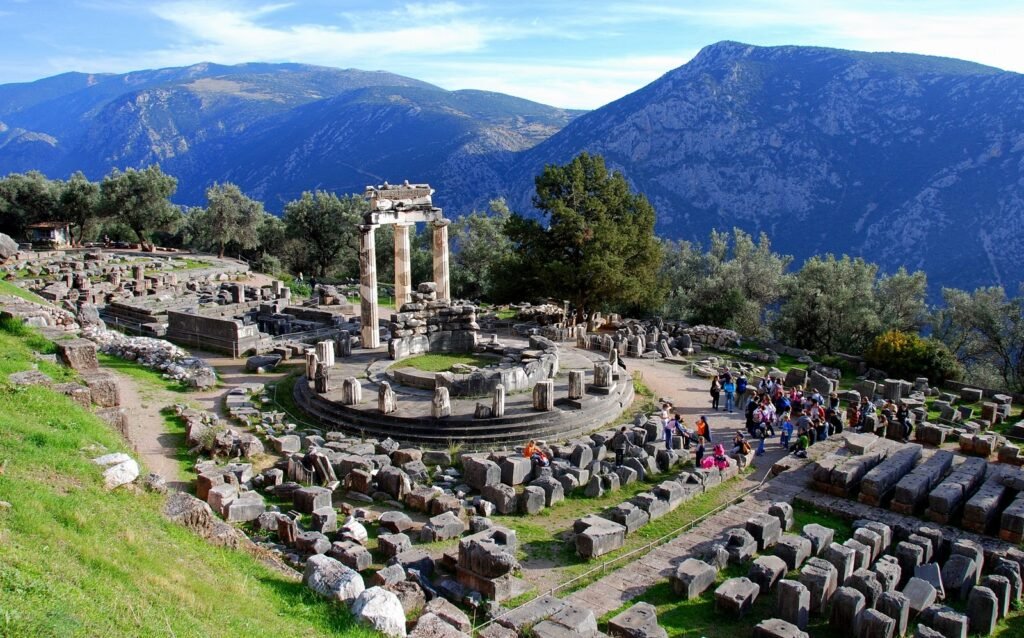
Delphi: Earth's Navel
It is hard to find another place where the religious imagination of the Greeks as much as the Delphi. Mounted on the slopes of Parnassus, above an impressive cliff, they constituted «umbilical» — literally the belly button. — of the world according to the ancients. This is where Apollo lived, god of divination, music and light.
- Pythia — the priestess carrying the prophecies — He sat over a crack on the ground, from where fumes came up, and spoke in a state of ecstasy. The rulers from all over the known world sent delegations to ask about wars, colonization, legislation or their personal decisions. The words of Pythia were ambiguous — never clear answer — which made them resistant to denial.
Olympia: Holy Place and Games
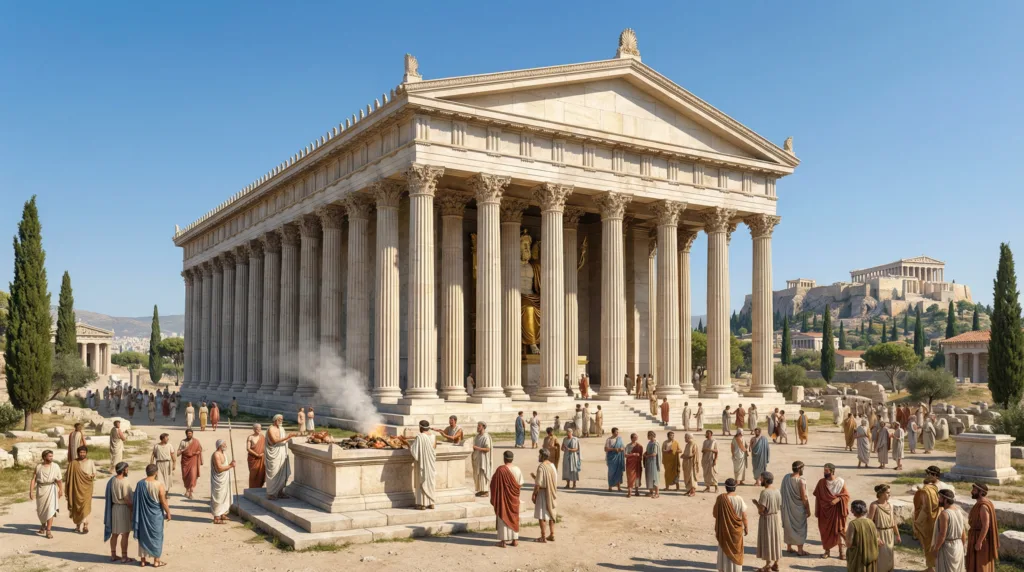
In the northwestern Peloponnese, at the confluence of the rivers Alpheio and Cladeos, one of the most important sacred mosques of antiquity was spread: Olympia. Here they mainly honored him Zeus, and here the Olympic Games were born, in 776 BC according to tradition.
It is important to understand that the Games were not a sporting event with a religious aspect—they were, first and foremost, a religious event with a sporting component. Every victory was dedicated to the gods. During the Games, the “Olympic Truce” was in effect—all hostilities ceased so that athletes and spectators could travel safely to Olympia.
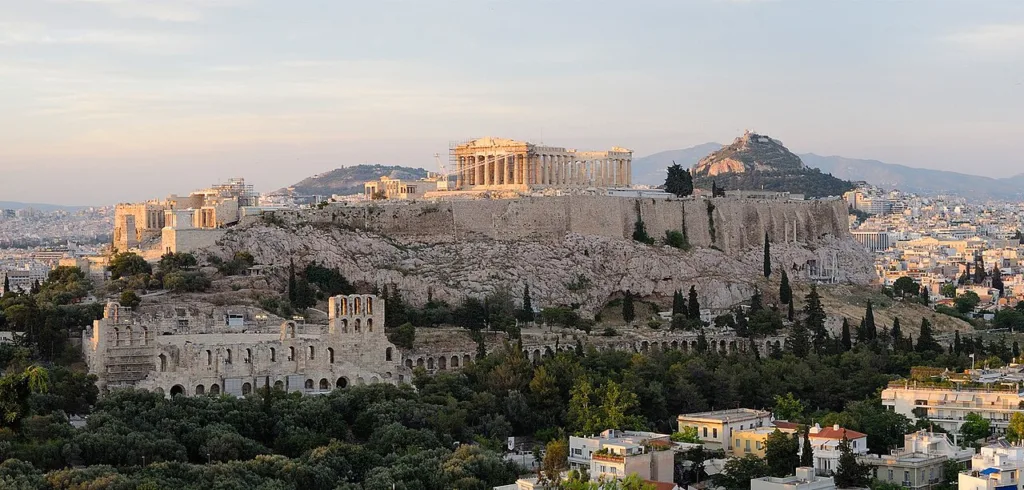
The Acropolis of Athens
No sacred place was as connected to a city as the Acropolis to the AthensThe Parthenon, its temple Athena Virgin, was both a temple and a symbol of political power — the embodiment of Athenian pride. The famous golden-leaf statue of the goddess, a work of Phidias, reached a height of 12 meters.
In addition to the Parthenon, the Acropolis was home to other important shrines: the Erechtheion, with its famous Porch of the Caryatids, and the temple of Athena Nike—a symbol of the city’s eternal victory.
Eleusis: The Mystery That Kept Its Secret
A few kilometers west of Athens, Elefsina, was held each year one of the most mysterious religious events of antiquity: Eleusinia Mysteries. Dedicated to Demeter And her daughter. Persephone, concerned the cycle of life, death and resurrection — Allegorically associated with the seasons and agriculture.
What was happening within the palace of mysteries remained one of the most well guarded secrets of antiquity. Mystics swore silence, and no one ever fully revealed the events. All we know is that those involved left deeply transformed, with another sense of death and death. After death. Beyond the Olympics, the ancient Greeks held three other major games that together constituted the «Panhellenic cycle»: the Pythias (in Delphi, in honour of Apollo), Nemea (in Nemea, for Zeus) and Isthmia (near Corinth, for Poseidon). Each city-state sent its best, and victories were celebrated with songs and statues.
These struggles were among the few things that united the Greeks despite their constant strife. In times of struggle, even wars cities Put the guns down. One of the most interesting aspects of Greek religion is its two-way relationship with philosophy. The great philosophers — Plato, Aristotle, even Socrates — They did not completely reject religion, but renegotiated it. Plato was talking about one. «Creator» Almost monotheistic, while Heraclitus openly questioned certain rituals.
The divinations were not just places for money. — were also information centres. Delphi priests, for example, maintained a vast network of contacts throughout the Greek world, which made their prophecies often deeply informed politically — Not just inspired divinely.
Conclusion: A Religion That Still Lives
The religion of ancient Greece was extinguished as a living practice, but never disappeared. Her myths survived in literature, art and language — thousands of words and expressions of our everyday life have Greek mythological origins. Her shrines — Parthenon, Delphi, Olympia — remain alive as archaeological sites and as cultural symbols.
Mainly, the Greek religion reminds us of something timeless: that man, at every time, seeks ways to signify the world around him, communicate with the unknown and face the inevitable. Ancient Greeks did it with gods that look terrifyingly human — and this, perhaps, is the most human thing of all.
If you want to deepen further into the society and culture of ancient Greeks, see our analytical guide:
Ancient Greece: Life, Cities and Culture
Greek Ethnogenesis 3000–700 BC: Pre-Hellenic, Early Greeks and Ancient Guardians