
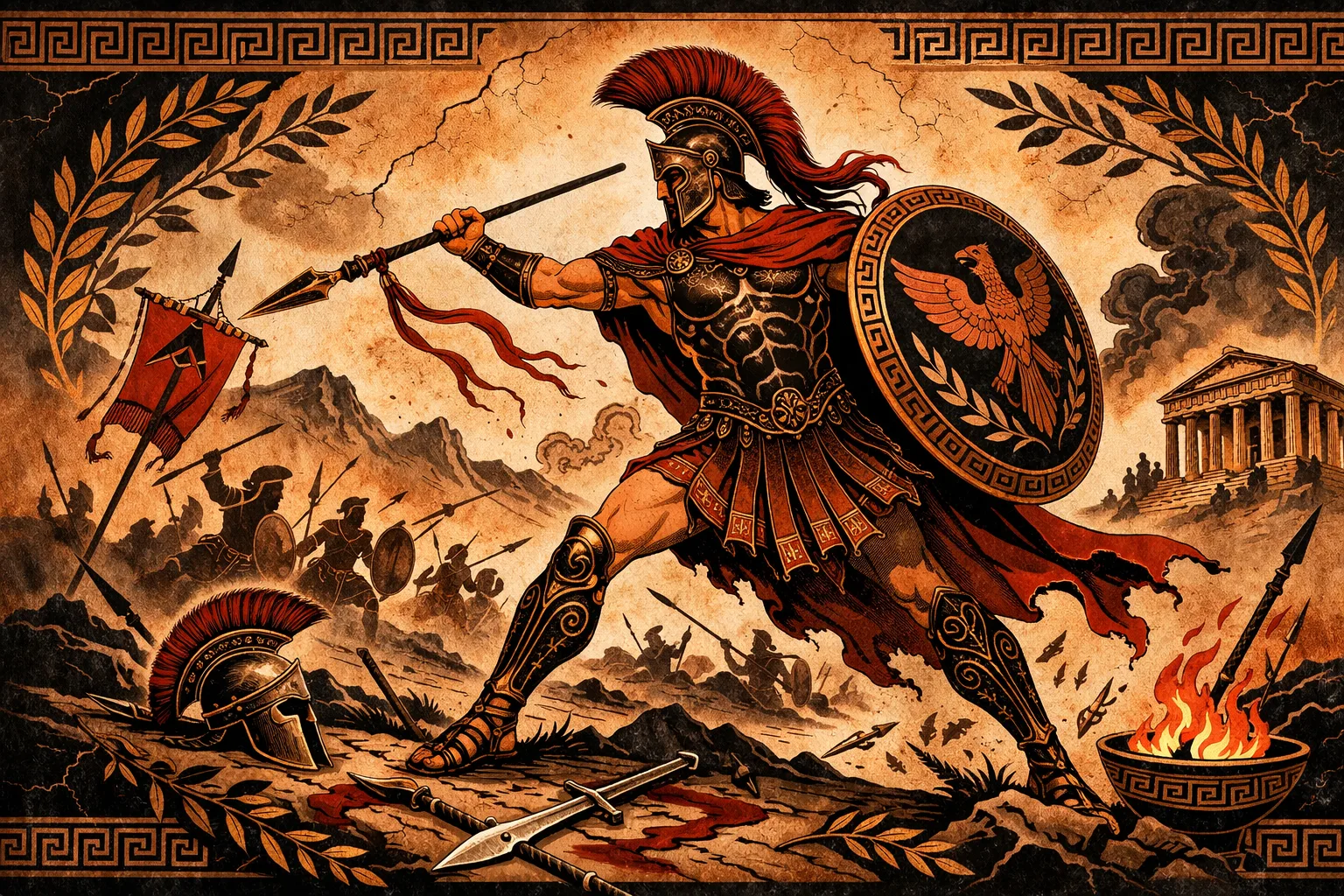
Ancient Greece, beyond the cradle of culture, philosophy and arts, has been a scene of countless war encounters. From the epic conflicts that mythology tells to the historical wars of the cities-states, the Greeks faced the war not only as a conflict for survival, but also as a means of testing valor, strategy and honor. Through these wars heroes emerged, alliances were formed, and stories that continue to inspire to date were born.
Even before history was written down, the Greek world had already been filled with narratives of epic conflicts. THE Trojan War, as Homer presented him in Iliad, is the symbol of the heroic era. There, rage and fate intersect with glory and death, while the conflict between Greeks and Trojans becomes an allegory for the perpetual human struggle between ambition and destiny.
He was equally dramatic. Thebaic cycle, with the history of the Seven on Thebes and the Argies who campaigned against the city. These mythical war stories formed the moral and cultural background of the Greeks, as through them they formed ideals such as bravery, faith in the comrades and the search for eternal fame.
By entering the historical era, the Greek world is divided into independent city-states, each with its own political organization, gods-protects and philosophy of life. The SpartaWith her disciplined military culture, she represented order, duty and rigour. On the contrary, the Athens was the center of democracy and spiritual enlightenment, but also a naval superpower seeking influence in the Aegean.
This differentiation inevitably led to conflicts. The desire for political sovereignty and control of trade routes sparked smaller or larger confrontations between the Greek cities, but also moments of unity in front of a common enemy. The threat of the mighty Persian Empire There was a rare point of sympathy among the otherwise divided Greeks. The Zero Wars (490–479 BC) tested the limits of their endurance and courage. The Battles of Marathon, Thermopylae and Salamis They indelibly carved the collective fantasy of Greeks and the Western world in general.
Resistance to a superior force, the self-sacrifice of Leonidas and Spartans, Themistocles' demon strategy, became symbols of spiritual and political freedom. These victories forged the belief that freedom is ideal superior to any material authority.
After the Persians were repelled, Greek cities failed to maintain their unity. On the contrary, competition for hegemony led to the long and exhausting conflict between Athens and SpartaThe Peloponnesian War (431–404 BC).
Athens, with its Republic, its cultural prosperity and strong naval power, collided with Sparta and its alliance. The war left behind disasters, famine, political twists and deep divisions. The weakening of Greek cities paved the way for the rise of Macedonia.
The union of Greek cities under Macedonian hegemony of Philip II It meant the end of the era of independent cities-states and the beginning of a new, World Greek eraHis son, Alexander the Great, took the baton and launched an amazing campaign that dissolved the Persian Empire and reached the depths of Asia.
His conquests not only spread Greek weapons, but also Greek culture, language and philosophy. Thus was born the Hellenistic world, a new synthesis of cultures that united West and East in a common spirit of knowledge and creation.
Conclusion
The wars of ancient Greece, whether mythical or historical, were not merely battlefields — have been mirrors of the values, contrasts, and visions of an entire world. From Achilles' heroism to the insight of Themistocles and Alexander's ambition, the Greek world lived and shaped the concept of war as a creative and destructive force.
Through these conflicts the consciousness of freedom, honor and the search for the superior ideal emerged — values that still move those who study the culture of ancient Greeks and the complexity of the human spirit. If you want to deepen further into the society and culture of ancient Greeks, see our analytical guide:
Ancient Greece: Life, Cities and Culture