

Calypso is a nymph of Greek mythology, known mainly for her role in «Odyssey» of Homer. She lives on the remote island of Ogygia, where he keeps Odysseus for seven years, offering him immortality if he agrees to stay with her. Finally, Zeus orders her to release the hero, so that he can continue his journey to Ithaca.
- Calypso, the nymph in the *Odyssey* She is one of the most mysterious and complex figures in Greek mythology. Her name is directly linked to Odysseus and his adventures after the Trojan War. If you’re searching for “Calypso in Greek mythology” or “the island of Ogygia and Calypso,” this article explains Calypso’s role, her story, and her significance in the *Odyssey*.
The Symbolic Meaning of Calypso
Calypso is one of the most complex figures in Greek mythology, because she functions not only as a mythical character but also as a symbol of inner struggle. Her presence in the Odyssey highlights the tension between the desire for security and the human need to remain true to one’s identity. As a nymph associated with an isolated place, she embodies the alluring aspect of stillness: a world far removed from pain, decay, and social obligations.
Symbolically, Calypso can be interpreted as the personification of the temptation of oblivion. She does not merely represent an external force, but an internal possibility: the choice to abandon the struggle for return, memory, and purpose. On this level, Odysseus It is not only contrasted with a divine presence, but with the possibility of stopping pursuing what defines it.
The immortality associated with the figure of Calypso also takes on a philosophical dimension. In Greek mythology, eternal life is not always presented as an absolute good; it can entail a severing from human experience. Calypso, therefore, highlights the paradox that mortality, with all its losses, is what gives weight to choices, relationships, and nostalgia.
Ogygia Island in Ancient Tradition
In ancient tradition, Ogygia is portrayed as a place on the edge, almost outside the normal geographical and human map. It is not merely an island, but a mythological place of exile, where time seems to pass differently. The description of the landscape—with its natural abundance, caves, trees, and waters—evokes an ideal yet closed-off world, more of an inner landscape than a mere geographical location.
In antiquity and in later scholarship, various attempts were made to identify Ogigia with actual locations. Some sought it in the western Mediterranean, others near Malta, while some more recent theories have placed it even farther away, in regions that reflect researchers’ desire to “map” the Homeric world. However, the significance of Ogygia is not limited to its possible geographical location.

| Item | Information |
|---|---|
| Name | Calypso |
| Species | Nymph |
| Residence | Ogygia |
| Father | Atlas (commonest tradition) |
| Appearance | Odyssey |
| Partner | Odysseus |
| Duration of stay | 7 years |
Ogygia as a mythological site
As a symbol, Ogygia is associated with isolation, the suspension of action, and the illusion of fulfillment. It is a place where everything seems sufficient, except for freedom of movement and choice. Thus, in the Odyssey, Ogygia serves as a counterpoint to the world of adventure: a place of stagnation within an epic of journey, quest, and return.
Calypso in Literature and Art
The figure of Calypso has held a special fascination in literature and the visual arts because she combines beauty, mystery, power, and melancholy. From antiquity to the modern European tradition, the nymph appears at times as an enigmatic deity of the maritime realm and at other times as a figure embodying the tension between love and loss.
In literature, Calypso often reappears in works that engage with the *Odyssey*. In more recent reinterpretations of the Homeric myth, her character often takes on greater psychological depth: she is not treated merely as an obstacle, but as a character who reveals human vulnerability in the face of loneliness and the desire for companionship. In James Joyce’s work, the title “Calypso” in an episode of Ulysses shows just how fruitful the mythological name has remained for modernist literature.
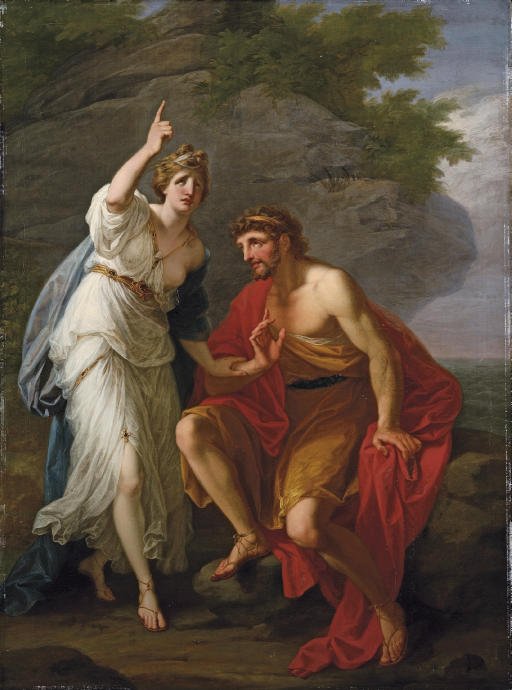
Calypso receiving Telemachus and Mentor in the Grotto by William Hamilton (18th century)
Visual and musical representations
In painting, Calypso was often depicted in scenes of tranquil seas, caves, or exotic landscapes, where natural beauty underscores her ambiguous character. Neoclassical and Romantic artists were particularly drawn to the emotional intensity of her figure. In music and opera, her name was used in works inspired by the Homeric cycle, highlighting the drama of a figure caught between divine grandeur and personal despair.
Calypso in Contemporary Culture
In modern culture, Calypso continues to be portrayed as a symbol of mystery, the sea, and irresistible charm. Her name is frequently used in books, TV series, movies, songs, and video games—not always with strict adherence to Greek mythology, but in ways that draw on her symbolic essence. Her association with isolation, desire, and the unknown makes her particularly well-suited for fantasy and adventure narratives.
In young adult literature, Calypso appears in reinterpretations of ancient myths, such as in works that reintroduce deities, heroes, and nymphs to a contemporary readership. There, she is often portrayed with greater emotional complexity, as a character who is not confined to a one-dimensional role. This reinterpretation reflects the broader trend of the era to reexamine female figures in mythology.
In film and television, the name “Calypso” is often used for characters associated with the sea, magic, or independence. Even when the connection is tenuous, a sense of ancient and unpredictable power remains. In video games and pop culture, Calypso often serves as an archetypal name for islands, missions, artificial intelligences, or female characters with an enigmatic presence.
Interesting Facts about Calypso
- The name “Calypso” is etymologically linked to the concept of covering or concealing, a trait that aligns with the secretive and secluded nature of her figure.
- In the *Odyssey*, Calypso is one of the characters who highlights not only the adventure of the journey, but also the emotional trials that accompany human perseverance.
- Many scholars consider Ogygia to be more of a mythical place than a real island, as it serves as the setting for an internal conflict.
- Calypso differs from many other female figures in Greek mythology because her power is expressed primarily through stillness rather than through action.
- Its form has been linked to ancient beliefs about nature deities, in which caves, springs, and forests were considered sacred and dangerous places.
- In more recent interpretations, Calypso is often portrayed as a figure who embodies the loneliness of immortality, a dimension that is not always apparent in simple retellings of the myth.
- Her image has influenced the literary concept of the “trap island”—that is, a place that appears to be paradise but restricts freedom.
- Her name has been used figuratively in works and titles not directly related to Greek mythology, precisely because it evokes mystery and charm.
- Calypso is often compared to other mythological female figures who test or transform the hero, although her role is more contemplative in nature.
- Its enduring resonance shows that secondary figures in ancient epics can take on new significance when examined using contemporary interpretive tools.
What We Can Learn from the Myth of Calypso
The myth of Calypso offers important lessons about freedom, self-determination, and the relationship between humans and their desires. In a modern interpretation, Calypso does not merely represent a mythological nymph, but a situation in which a person is faced with something appealing that may, however, lead them away from their personal goal.
A key lesson is that comfort does not always equate to happiness. There are times when staying in a safe, familiar, or pleasant environment can hinder personal growth. Ogygia, as a place of abundance but also of isolation, reminds us that true fulfillment requires action, choice, and taking responsibility.
Myth also sheds light on the value of memory. A person’s identity is shaped not only by what they desire in the present, but also by what they remember, promise, and strive for. In the Odyssey, constant nostalgia is not a weakness; it is a strength that keeps the direction of life alive.
Finally, Calypso invites us to reflect more deeply on the relationship between love and freedom. Any bond that deprives us of self-determination ceases to be liberating, even if it offers security or admiration. The essence of the myth remains relevant today: freedom is a necessary prerequisite for any authentic choice.
FAQ
Why is Calypso considered so enigmatic in Greek mythology?
Calypso is considered enigmatic because she combines beauty, divine power, compassion, and emotional vulnerability. Although she keeps Odysseus on Ogygia, she genuinely loves him and ultimately obeys Zeus' command to let him leave. This combination of love, loneliness, and duty makes her one of the most complex female figures in Greek mythology.
Are there different traditions regarding the appearance of Calypso?
Yes, in ancient literature, there are variations and differences regarding her place in the mythological world. Later writers often adapted her character to suit the needs of their works, emphasizing at times her divine nature and at other times her emotional dimension.
What does Calypso mean for the study of female figures in ancient epics?
Calypso is significant because she demonstrates that female characters in the epics do not merely serve as supporting figures. They can express philosophical questions, moral dilemmas, and existential choices. Contemporary scholarship often examines her as a character with her own internal tragedy.
Why is the name of Calypso so often used in modern art?
The name has a strong phonetic and symbolic power. It evokes secrecy, mystery, the sea, and ancient charm. That is why it is often used even in works that do not strictly follow the Odyssey but seek to create an atmosphere of mythical depth.
How does Calypso differ from other nymphs of mythology?
Many nymphs are primarily associated with natural landscapes, such as springs, forests, or mountains. Calypso, however, plays a more prominent narrative and symbolic role. She is not merely the spirit of a place, but a figure linked to major themes in Greek mythology, such as memory, desire, choice, and human perseverance.
The identity of Calypso in Greek mythology
Calypso was a sea nymph, daughter of Titan Atlas According to some sources, or, according to others, some other nature deity. He lived on the isolated island Ogygia, a place filled with the sea, lush green trees, and mysterious beauty. The island of Ogygia is considered a symbol of isolation, eternal youth, and the charm associated with nymphs in Greek mythology.
Calypso, like all nymphs, embodied the power of nature, beauty, and temptation. She is described as wise, strong, and deeply emotional, capable of drawing people away from the real world.
The role of Calypso in the Odyssey
In Homer’s Odyssey, Calypso holds him Odysseus on its island seven years, offering him food, shelter, and the promise of immortality if he stays with her. Despite her love and her desire to make him immortal, Odysseus remains committed to returning to Ithaca and his family.
Calypso, the nymph in the *Odyssey*, exemplifies the conflict between human desire and the fate imposed by the gods. With the help of the gods, especially that of Athena and Zeus, Odysseus finally leaves the island of Ogygia and continues his journey.
Calypso and Ogygia Island: symbol and mythological space
The island of Ogygia and Calypso are intertwined concepts in Greek mythology. The island symbolizes a place of enchantment, safety, but also confinement. Calypso, the nymph who offered Odysseus immortality, embodies the trap of beauty and charm that can keep a person from real life.
In art and literature, Calypso has been a source of inspiration for painters, poets, and writers, embodying temptation, charm, and eternal youth.
The symbolism of Calypso in the Odyssey
Calypso is not just a nymph holding a hero. Symbolizes:
The temptation of charm and power
Security offered by isolation
The conflict between love and loyalty to the country
The power of nature and gods in human life
Her love for Odysseus and her offer of immortality reveal the complexity of the nymph, who can hold a hero captive yet also acknowledge the truth of his fate.

Sources and bibliography for Calypso
Ancient Sources
Homer
- Homer.Odyssey a' 13–59.
- First reference to Calypso as the bride and daughter of Atlas.
- Homer.Odyssey e 1–281.
- Hermes' visit to Ogigia, Zeus' command, and Odysseus' departure.
- Homer.Odyssey g' 244–266.
- Nausicaa's account of Odysseus's stay near Calypso.
Hesiod
- Hesiod.Theogony 359.
- It mentions an Oceanid named Calypso, distinct from her nymph in Odyssey.
- Hesiod.Theogony 1017–1018.
- Calypso gives birth to Nausithoos and Nausinoos, whose father is Odysseus.
Apollodorus
- Apollodorus.Library, Subsection 7.24–25.
- Summary of Odysseus’s stay on Ogygia and his departure.
Apollonius Rodius
- Apollonius Pomegranate.Argonauts IV 573–575.
- Report to Calypso as the daughter of Atlas.
Hygiene
- Hyginus.Fabulae 125.
- He delivers the genealogy of Calypso.
- Hyginus.Fabulae 243.
- Later tradition that Calypso commits suicide by her love for Ulysses.
Modern Bibliography
- Crane, Gregory. Calypso: Backgrounds and Conventions of the OdysseyAthenäum, 1988.
- Gantz, Timothy. Early Greek MythJohns Hopkins University Press, 1993.
- Hard, Robin. The Routledge Handbook of Greek MythologyRoutledge, 2004.
- Griffin, Jasper. Homer: The OdysseyCambridge University Press.
- Stanford, W. B. The Odyssey of HomerMacmillan.
Read more
Odysseus: His Story, Adventures, and the Lessons of the Odyssey
Calypso, the nymph in the *Odyssey*: Her story in Greek mythology
Scylla and Charybdis, Odysseus's deadly trap
Cyclops and Polyphemus: The One-eyed Giants of the Gods and Odyssey