
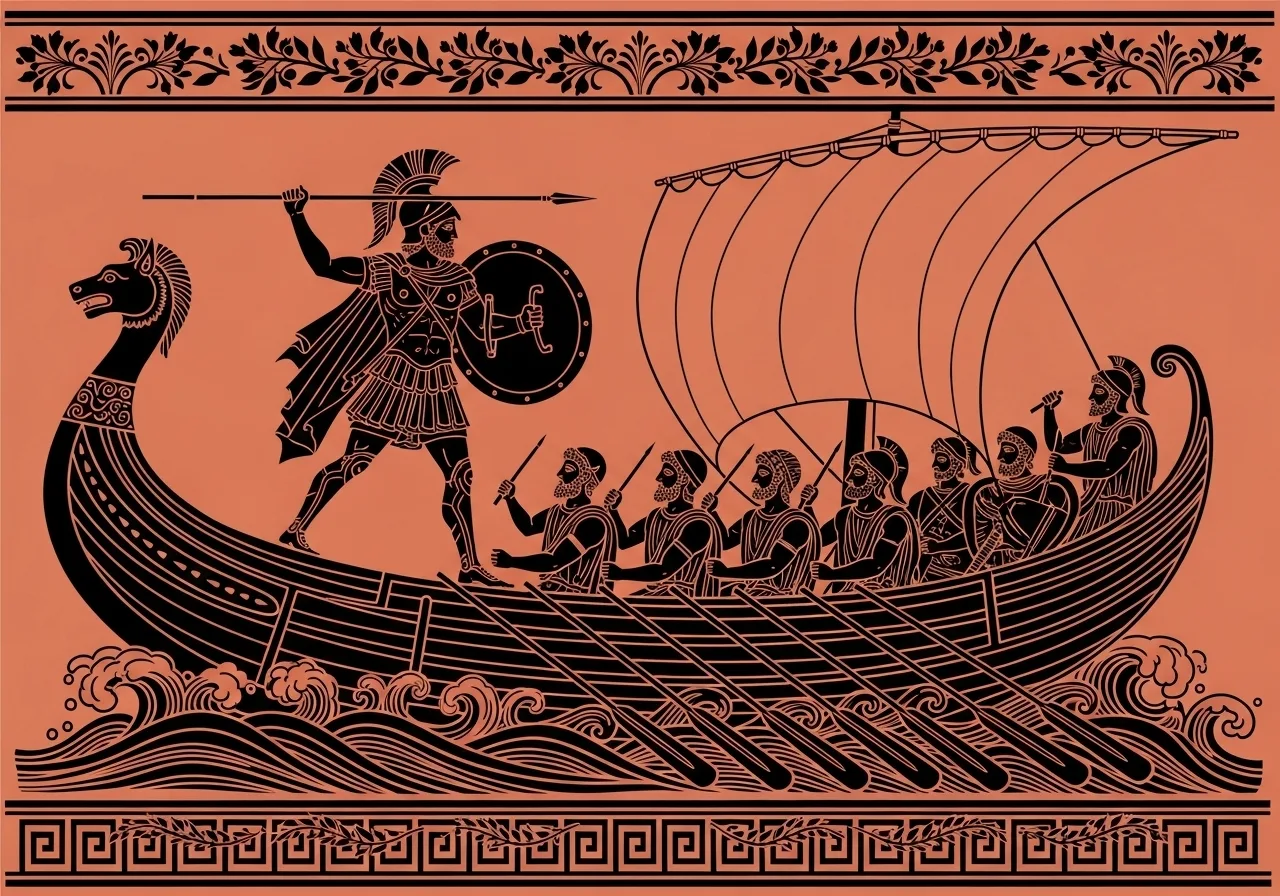
Jason and the Argonaut Campaign: the myth of the Golden Fleece
- Argonaut Campaign is one of the most exciting and multi-level myths of ancient Greek mythology. At its centre lies the Jason, the legal heir to the throne of Iolkou, who begins an extremely dangerous journey in order to acquire the Golden Fleece. This mission is not just a heroic adventure; it is a story about the legality of power, human ambition, hero cooperation and power—and ambivalence—Love and magic.
The myth of the Argonauts was particularly beloved in ancient times and left a strong imprint on poetry, angiography, dramaturgy and later literature. From Pomegranate until Roman and younger readings, Jason remains a form that causes admiration, but also criticism: is he a hero with a mission or man who relies excessively on the help of others?
Who was Jason?
Jason was his son. Aeson, the legal king of Iolkou in Thessaly. When the throne was usurped by PeliaJason grew up away from his homeland and later returned to claim the authority he owned. In the mythological account, Jason is not the typical warrior or undefeated semi - god. He is more a leader of the mission, a hero who needs allies, technical intelligence and divine favor to succeed.
Pelia's most well-known demand was seemingly impossible: Jason bringing it Golden Fleece From Colchis, to the ends of the known world. Pelias thought it would get rid of him. Instead, this requirement led to the formation of one of the most famous groups of heroes in Greek mythology.
What's a Golden Fleece?
The Golden Fleece was the skin of the holy ram that had saved him Frixos and Ellie. According to legend, this ram was given by Hermes or had divine origin and carried the two children away from danger. Ellie fell into the sea —Hence the name Hellespont— while Frixos reached Colchida, where he sacrificed the ram and dedicated the skin to Mars, hanging it in a sacred grove and placing it under the guard of a dragon.
The skin has been interpreted in many ways: as a symbol of royal legitimacy, as a sacred object of wealth and power, but also as a mythical reflection of technical or geographical knowledge of antiquity. In some newer interpretations it is associated with gold mining through skins in river areas of the Caucasus, but there is no historical certainty. What is certain is that in myth it acts as a supreme prize, which transcends material value and acquires almost sacred character.
Argo and the formation of Argonauts
The main symbol of the campaign is Argo, the ship built to carry Jason and his companions to the uncharted route to Kolchis. According to tradition, Argo built Argos with its help Athena, and a portion of its timber came from Dodoni, which gave the ship an additional sacred and divination character.
The Argonauts It wasn't a random team. Among them were top figures of Greek mythology, such as:
- Hercules, the greatest hero of Greek tradition, participating in the initial phase of the campaign.
- Orpheus, whose music acts as a force of order and salvation.
- Beaver and PolyducThe Dioscuri.
- Peleas, father of Achilles.
- Atalanti, in some traditions, although its presence is not uniform in all versions.
- Melegar, Laertis, Seeker, Kalais And many more heroes who gave the myth a nationwide character.
This composition shows that the campaign acts like a mythological «Meeting» The most brilliant heroic forces in Greece. It's not just a man's adventure, it's a collective feat.
The departure from Iolko
The march begins in Iolko, where Jason presents himself to Pelias and is invited to perform the mission. Important is her scene loss of sandalJason carries an old woman—I would like to thank the rapporteur for his report. Hera disguised—And he loses one of his sandals passing the river. This sign is associated with an oracle that warned Pelia to fear the man who would appear with a sandal.
This detail has a special narrative weight: the hero is recognized not by his power, but by an almost random external mark. Fate, coincidence and divine providence overlap from the first moment.
The journey to Kolchida
The Argonaut journey was not straight. It passed through islands, coastal areas and enemy zones of the Mediterranean and Black Sea, including trials that endangered the mission at every stage.
Limni women
In Limnos, the Argonauts were found in a society where women had killed their men. This myth incorporates themes of overthrowing the social order, erotic attraction and temporary suspension of the heroic mission. The Argonauts remain there for a while, before being forced to continue their journey.
Midas and the traps of hospitality
In some traditions, the journey includes other attitudes where hospitality, greed, or violence test heroes. The recurring theme is clear: success depends not only on courage, but also on the ability of heroes to manage human and superhuman forces.
The Complete Stones
One of the most iconic episodes is the passage from Supplements, the colliding rocks blocking the sea road. With the help of the goddess Athena and the guidance of the seer and hero Phineas, Argonauts manage to pass through, often with the loss of certain objects or elements of the ship. The episode illustrates the transition from familiar to unknown, from human order to chaos of the world's boundaries.
Phineas and harpies
The blind seer Phineas is an important form of the route. Tortured by the harpies who grabbed his food, he is saved by the sons of Vorea. In return he gives the Argonauts valuable advice on the continuation of the journey. This episode shows that knowledge, divination, and proper guidance are as critical as physical bravery.
Colchis and King Aetis
Reaching the Colchis, Argonauts face the king Eagle, son of the Sun, who sets Jason impossible trials before giving him the skin. Jason must live. the fire-breathing oxen Mars, plow a field and sow dragon teeth, from which armed warriors will grow.
These trials are characteristic of mythical logic: the hero faces not only an enemy, but a world organized to rule him out. Its success depends on a new, decisive presence: Medea.
Medea: the most decisive form of myth
- Medea, daughter of Aetis and priestess or master of magic, falls in love with Jason with the help of Venus or divine intervention. In her face meet love, knowledge, magic and tragedy. Medea gives Jason the means to complete the trials: drugs, advice and tricks that allow him to survive.
Their relationship is one of the most complex in ancient mythology. This is not a romantic romance with a happy ending, but a union founded on violence, treason and mutual dependence. Medea leaves her homeland, betrays her father and helps Jason steal the Deras. This act will have disastrous consequences later, both for her and Jason himself.
The role of Medea in Jason’s success
Without Medea, the mission would likely fail. She guides him in how to face the warriors who will emerge from the dragon's teeth and reveals to him how to sleep the guardian dragon of the Fleece. In other words, Jason's success is unthinkable without her contribution. This is one of the reasons why the myth has such intense dramatic power: «hero» He is not self-sufficient, but dependent on a woman whom he will later abandon.
The Grab of the Golden Fleece
After the trials, Jason and Medea arrive at the sacred grove where Deras is guarded. The dragon, a symbol of alertness and forbidden wealth, bypasses or sleeps through the botanical and magical tricks of Medea. Jason takes the Deras and the mission, at least as to its original goal, is completed.
But the event is not triumphant in the simple sense. The theft of Deratos, the flight from Colchis and the betrayal of Aeite mark that the feat is accompanied by moral and political ambiguity. The myth does not offer a clear distinction between the just hero and the unjust opponent; instead, it highlights the complexity of the heroic act.
Return and consequences
The return of Argonauts is no less dangerous than leaving. In some versions of the myth, Aetis pursues the fugitives, while Medea reaches the extremes to ensure their escape. Later traditions include dark episodes, such as its cutting UnwroughtBrother of Medea to delay the pursuit. These patterns show how deeply Greek mythology links success with blood, loss, and moral costs.
When Jason returns to Iolko, Pelias does not immediately surrender the throne. In many traditions, Medea contributes to his death by a trick reminiscent of ceremonial youth and renewal, turning Pelia's end into dramatic comment on the illusion of authority and punishment of the hybrid.
Jason and Medea: From salvation to tragedy
The most known later follow-up to history is tragedy of Jason and Medea. In classical literature, especially in Euripide, Medea appears as a betrayed wife reacting horribly to Jason's decision to abandon her for a political marriage. So Jason from a savior and hero turns into a person morally problematic, while Medea from an assistant to the feat becomes a form of vindictive power and extreme tragedy.
This evolution makes the myth extremely timely and timeless: it shows how success can destroy the relationships that made it possible. The Argonautic Campaign does not end with the Deras, but with the consequences of the choices made for its acquisition.
What does the Argonaut Campaign symbolize?
The Argonaut Campaign has a rich symbolic load and can be read at many levels:
- Heroic adulthood: the journey as a test of maturation and self-realization.
- National cooperation: the union of heroes from different regions of Greece.
- Limits of the known world: the sea path to the edge of the world.
- Power and legalityJason claims the throne through feat, not with hereditary right only.
- The ambiguity of aidThe hero achieves thanks to the contribution of others, especially Medea.
- Moral cost of winning: every success is accompanied by losses and ruptures.
Historical and cultural readings of the myth
Historically, the Argonautic Campaign is not a real event, but the myth reflects ancient conceptions of navigation, trade, contacts with the Black Sea and the boundary zones between the Greek world and «others» Peoples. Colchis, for example, is placed at the eastern ends of the known world and acts as an area of exoticity, wealth and danger.
At the same time, the myth strengthened the cultural memory of many Greek cities. Many places claimed ties with the Argonauts, while the narrative helped shape a common nationwide heroic tradition, even before the classical historical consciousness was established.
Argo as a symbol of naval expertise
Argo, as a ship capable of facing unknown seas, has also been interpreted as a symbol of the technological progress of the Greeks of the early era. In myth, the sea is not just a passage corridor; it is a field of testing and knowledge. The ship carries not only bodies, but also the very boundary between the city and the unknown.
The Argonautic Campaign in Literature and Art
The myth of Argonauts was edited by many ancient writers and artists. The most complete surviving epic is Argonauts of Apollonius of Rhodes, work of the Hellenistic era that offers detailed and psychologically complex narrative. The story also appears in tragedies, fragmentary epics, and numerous visual performances.
In angiography, Argonauts are often presented in scenes of departure, travel or return, while Jason and Medea acquire particular pictorial significance due to their dramatic relationship. The myth also influenced Roman literature and remains alive in modern poetry, theatre, and modern narrative.
Why does Jason’s myth remain timely?
The timelessness of the Argonaut Campaign is due to the combination of adventure, politics, psychology and moral reflection. Jason is not a one-dimensional hero. He is a man with a goal, with a need for allies, with divine support and with weaknesses. Medea, on the other hand, is one of the most dynamic and tragic forms of world mythology.
Through these two characters, the myth persistently asks: What does success cost? Who pays the price of power? and how stable is human commitment when it conflicts with the interest?
Frequently asked questions about Jason and Argonauts
Who was Jason in Greek mythology?
Jason was the son of Aeson and the leader of the Argonaut Campaign. His goal was to bring the Golden Fleece from Kolchis and claim the throne of Iolkou.
What was the Golden Fleece?
It was the skin of the holy ram that saved Frixos and Ellie. In myth it acts as a precious and sacred prize, symbol of royal power and success.
Who was Medea?
Medea was the daughter of King Aetis of Colchis and one of the most important figures of the myth. He helped Jason acquire the Deras, but their relationship ended in tragedy.
Who were the Argonauts?
The Argonauts were the heroes who accompanied Jason to Argo. Among them are Hercules, Orpheus, Dioscuri, Peleus and other iconic figures of Greek mythology.
What does Argo symbolize?
Argo symbolizes the journey to the unknown, the collective effort, the know-how of navigation and the transition from the known world to the extreme trials of heroic adventure.
What is the significance of the Argonaut Campaign?
The campaign combines myth, historical memory and cultural symbolism. It is one of the most important examples of ancient Greek heroic tradition and continues to inspire literature and art.
Conclusion
His myth Jason and the Argonaut Campaign It's not just an adventure with ship, heroes and monsters. It is a complex account of the desire, ambition, cooperation, betrayal and price of success. The Golden Fleece Dera, Argo, Medea and Argonauts compose one of the most powerful mythical circles of antiquity, with influence that reaches to this day.
If we want to understand why this myth remains alive, the answer lies precisely in the human truth it hides: every great mission requires courage, but every courage also leaves its consequences behind. And perhaps that is why Jason is not just an ancient hero; he is a timeless image of the man who pursues the impossible.
Jason
| Name | Jason |
|---|---|
| Parents | Aesonas and Polymede (or Alkimed) |
| Residence | Iolcus (Thessalian) |
| Roles and Responsibilities | Leader of Argonauts, Seeker of the Golden Fleece, exploring hero |
| Other Names | Jason Thesalos |
| Husbands | Medea |
| Children | Medusa, Ferris, Mermeros (in various traditions there are variations) |
| Symbols | Argo, Golden Fleece, ship, travel |
| Roman Name | Jason |
Read more
The Legend of Frixos and Helle