
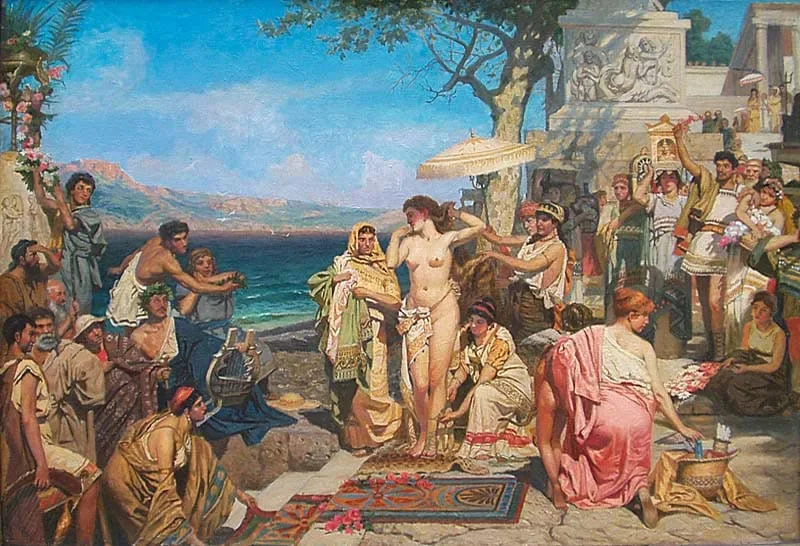
Orphic Mysteries
Cosmology, Ritualism and Salvational Thought in Ancient Greece
Orphism
Orphic Mysteries are one of the most complex and peculiar religious phenomena of ancient Greek religion. Unlike the public, ceremoniously constant worship of the Olympian gods, orphism introduces an inner, salvationological dimension, focusing on the immortality of the soul, the cleansing and redemption from the cycle of reincarnations. This article examines the origin, mythology, cosmology, ritual practices and the importance of Orphic Mysteries in the context of ancient Greek religious thought.
1. Introduction: Orphism as a religious stream
The term Orphic Mysteries refers to a set of beliefs, myths, and ritual practices attributed to the mythical poet and myster Orpheus. Orphism was never a single, institutionalized religious system, but rather a religious and philosophical current, which coexisted with the official worship of the cities–states.
The central element of orphism was the belief that the human soul carries divine origin, but is found trapped in the body as punishment or result of secular error. The aim of life was to cleansing of the soul And her final release.
2. Orpheus: Myth and religious authority
Orpheus, son during the tradition of Muse Kalliopi and either Oiagros or Apollo, is considered the founder of Orphic Mysteries. His mythical descent to Hades for Eurydice gives Orpheus unique knowledge of posthumous world, which strengthens his authority as a revealing teacher.
In ancient consciousness, «orphate» texts were not considered simple poetry, but sacred revelation, transmitted through initiation.
3. Orphic Cosmogonia and Theogonia
Orphic cosmology differs considerably from Hesiodia theogenia.
3.1 The Cosmic Egg
According to Orphic traditions:
From Chaos born Cosmic Egg
It is clear from this that Fanis (or Primitive), deity of light, life and creation
Fanny is considered the primary source of divine creation, incorporating male and female principles.
3.2 Dionysus Zagreus
Of particular importance is his myth Dionysus Zagreus, which is dismembered by the Titans. From the punishment of Titans and their ashes mankind is born.
???? Man is both titanic and divine, bringing within him the seed of Dionysus.
4. The Soul in Orphism
Orphic anthropology is founded on three basic principles:
Immortality of the soul
Re psychosis (reincarnation)
Moral responsibility
The soul wanders in successive lives until it is fully cleansed. Body considered a prison of the soul (p. = p.m.).
5. Ceremony and Initiation in Orphic Mysteries
Orphic Mysteries were not held in a certain sacred place, such as Eleusinia, but were practiced by Wandering mystics and priests.
5.1 Initiatory Practices
The initiation included:
ceremonial purification
reciting sacred hymns
Secret teaching of cosmological truths
5.2 Orphic Life
The initiates had to follow a strict lifestyle:
abstaining from meat
avoid bloodshed
moral self-defense
6. Orphic Golden Plates
Archaeological findings of great importance are Orphic gold plates (lamellae), placed in mysterious tombs.
They contain instructions to the soul in Hades:
«We are all sons and fathers.»
These plates confirm the orphic faith in salvation through knowledge.
7. Relationship with Other Mysteries and Philosophy
Orphism deeply affected:
Pythagoism
Plato
later sotirological religions
The Platonic perception of soul and purgatory bears strong orphic elements.
8. Historical Assessment and Contemporary Research
Modern scientific research treats orphism as:
religious movement of an internal character
alternative cosmology within Greek polytheism
precursor of philosophical and soteriological thought
9. Conclusions
Orphic Mysteries recommend a deep spiritual tradition, which redefined the relationship between man and uncle in ancient Greece. With emphasis on the soul, moral responsibility and redemption, orphism has been one of the most important internal expressions of ancient Greek religion.
Indicative Bibliography
Burkert, W. Greek Religion
Guthrie, W.K.C. Orpheus and Greek Religion
Parker, R. On Greek Religion
Graf, F. & Johnston, S. Ritual Texts for the Afterlife