
Introduction
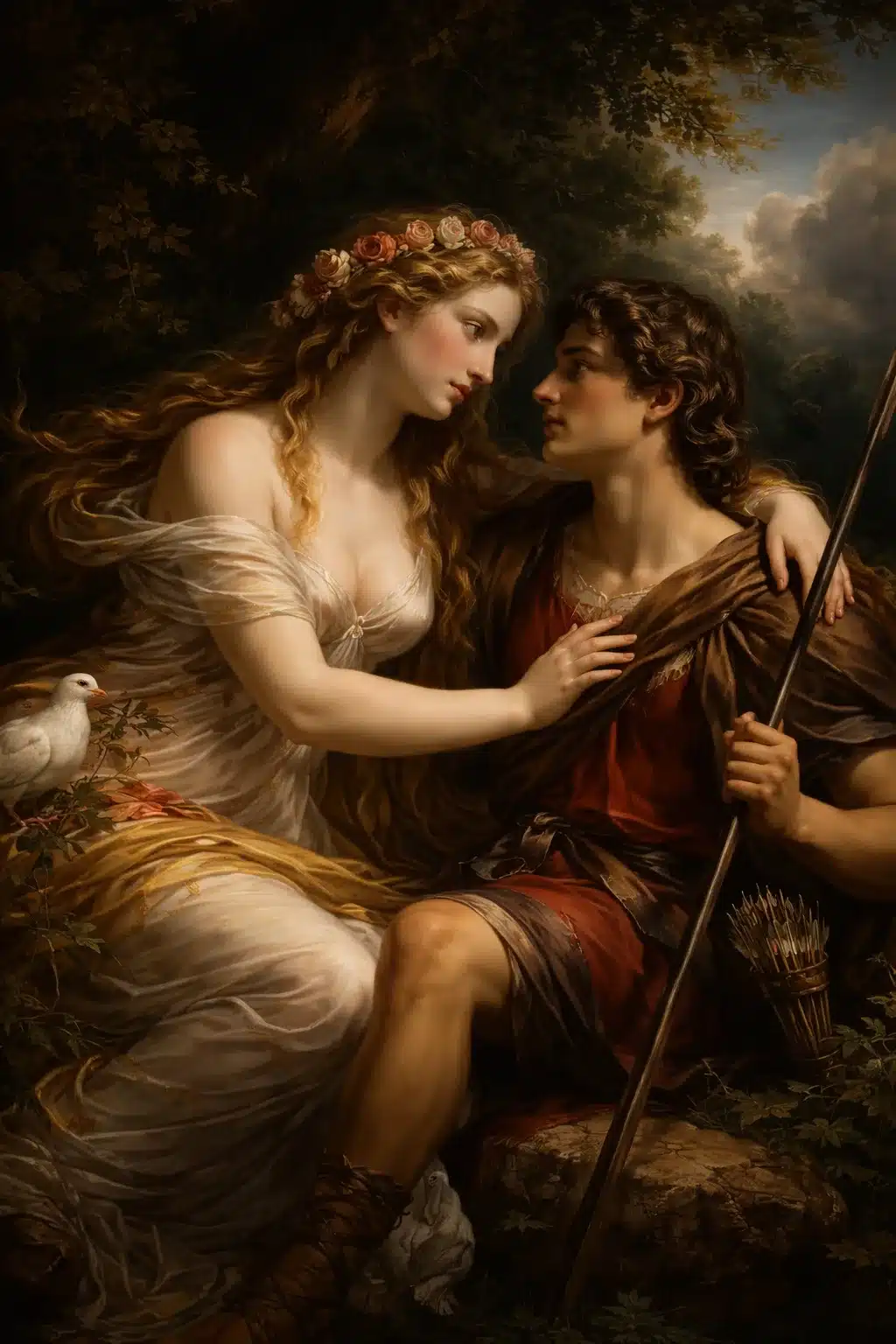
Among the most touching myths of ancient Greek mythology, its myth Adonis and Aphrodite He stands out for the intensity of the emotions he relates. Adonis was, according to tradition, a mortal young man so dazzling of beauty to gain the heart of Venus, goddess of love and beauty itself.
The myth of Adonis and Venus is considered one of the most beautiful of Greek mythology not only because of its dramatic plot, but because it condenses into an account of some of the most timeless human themes: love that knows no boundaries, jealousy that destroys, and death that comes to abruptly interrupt all beauty. It is no coincidence that the myth inspired countless artists, poets and thinkers from ancient times until today.
What makes the myth of Adonis particularly interesting is also its origin: it is a narrative with roots in the Near East, which was gradually incorporated into Greek religion and mythology, maintaining elements of cults of vegetation and seasonal renewal. In this article we will examine in detail the origins of Adonis, his love with Venus, the controversy of the goddess with Persephone, his tragic death, the celebration of the Adonis, as well as the symbolism and cultural influence of the myth until today.
The Origin of Adonis
King Kinura and Myrna
Ancient sources disagree on the details of Adonis' birth, but the most widespread version, as rescued by Apollodorus THE Library He wants him the son of Smyrna (or Myrra) and her father, King Kinura of Cyprus. According to this tradition, Smyrna neglected to honor Venus, and the goddess, as punishment, inspired her with a strange and unfair love for her own father.
With the help of her nanny, Smyrna managed to sleep with Kinura for several nights, without realizing her identity. When Kinuras discovered the fraud, he pursued his daughter with a sword, wanting to kill her.
The transformation into a myrrh tree
The gods, sorry for Smyrna, transformed her into a myrrh tree. The Ovid, on Transformations His, he describes with special sensitivity at this time of transformation, stressing how even as a tree the heroine continued to mourn for her act, as her tears became the precious perfume of myrrh.
After nine months, the trunk of the tree opened and an infant of dazzling beauty came out: Adonis. According to some versions, it was Venus herself, filled with pity for the infant, who helped in his birth, while other traditions refer to Illiteracy or The Moirai (Fates).
Different versions of the myth
It is worth noting that not all sources agree with Adonis ’ parents. THE Hesiod, in excerpts rescued, he seems to mention a different genealogy, while other traditions place his birth in Syria instead of Cyprus, reflecting the eastern origin of the myth. Antoninos Liverpoolis and Comments to Theocrito also offer variations, showing how fluid the tradition of the birth of this special hero of Greek mythology was.
The unparalleled beauty of Adonis
From the time of his birth, Adonis was considered the ideal of male beauty. Ancient writers describe a beauty so impressive that it transcends human measures, reaching out to compete with that of the gods themselves.
Venus herself, according to legend, was so enchanted by the beauty of the infant that she decided to hide it in a box and trust it in Persephone, Queen of the Underworld, to raise it away from indiscriminate looks. But Persephone, once she saw the child grow, was equally fascinated and refused to return it. —which would later lead to the well-known controversy of the two spectators.
The extraordinary beauty of Adonis is not just a aesthetic element of the myth· it works symbolically as a representation of ephemeral youth and human acne, which precisely because it is so brilliant, is also so vulnerable to time and death.
Venus' love
How love was born
As Adonis grew up and became a young man of impressive beauty, Venus passionately fell in love with him. According to a version quoted by Apollodorus himself Eros, the son of the goddess, accidentally struck his mother with one of his arrows, thus causing the outbreak of this unusual passion between goddess and mortal.
Other traditions show Venus being fascinated directly by the beauty of the young, without the intervention of an external agent, more directly highlighting the power of Adonis' own armour.
Their common life
Ovide vividly describes how the goddess, forgetting her usual duties and the honors of Olympus, preferred to spend time on earth along with her beloved. He even abandoned the Sparta, Cyprus and its sacred places of worship in order to follow Adonis on hunting excursions to the forests and mountains.
The goddess, according to legend, transformed herself —abandoning its usual elegance— to participate in hunting, wearing simple clothes suitable for the countryside, something completely unusual for the goddess of beauty and luxury.
Venus’ warnings
Knowing the dangers of hunting, Venus repeatedly warned Adonis to avoid wild beasts —lions, wolves and wild boar— And hunt only more harmless animals. This detail, found mainly in Ovid, already foretells the tragic conclusion of the myth, creating a sense of inevitable fate that penetrates the entire narrative.
The relationship between an immortal goddess and a mortal young man is in itself an interesting aspect of love in Greek mythology, as it highlights the unbridled gap between divine eternity and human mortality —a gap that will eventually prove fatal.
Venus’ controversy with Persephone
The delivery of the infant
As reported, Venus, wanting to protect the infant Adonis, trusted it in a closed box in Persephone. The Queen of the Underworld, however, once she opened the box and saw the beauty of the child, stubbornly refused to return him, wanting to keep him to herself.
Jupiter's intervention
The controversy between the two goddesses reached Olympus, and eventually needed his own intervention Zeus to be resolved. According to legend —As Apollodorus rescues him— Zeus entrusted the crisis to Musa Calliope, his mother Orpheus, while other versions say that the decision itself was made directly by the father of the gods.
The agreement of the season
The solution given was extremely symbolic: Adonis would spend some time with Persephone in the Underworld, another place with Venus in the upper world, and —according to certain traditions— he would also have a time free to choose for himself what goddess he would like to spend more time with, a choice that, as it is said, he always did in favor of Venus.
This tripartite distribution of time is closely linked to the cycle of seasons and vegetation: Adonis' stay in Underworld symbolically correspond to winter months when nature «He dies.», while its return to the surface symbolizes the spring and regeneration of vegetation. Venus and Persephone controversy, therefore, is not just a sexual confrontation, but it reflects deeper the natural rotation of life and death on earth.
The death of Adonis
The version of the boar
The most widespread version of Adonis' death, found in Apollodorus, Ovid and Vion the Smyrnaus in his poem Epitaph Adonis, reports that the young man was killed by a wild boar during a hunt, who fatally hit him in the groin with his tusks.
The jealousy of Mars
A particularly widespread tradition attributes Adonis' death to the jealousy of God Ares, her lover Aphrodite, who, unable to bear to see the goddess in love with a mortal, transformed himself into a boar —Or sent a butcher— To kill his rival. This version adds to the myth an intense dimension of passion and revenge, linking Adonis' death directly to jealousy in Greek mythology.
The wrath of Artemis
Other sources, as quoted in Comments to Theocrite, link Adonis' death to her wrath Artemis, which, as a goddess of hunting and chastity, was probably jealous of either the beauty of the young man or his ability as a hunter, sending the carter against him as punishment.
Other deliveries
There are also versions reporting involvement of Apollo, while in some eastern variations of the myth the death of Adonis is associated with more primitive vegetation accounts, where the death of the new god corresponds to dry summer or to the deterioration of the earth during the summer months, depending on the geographical origin of tradition.
It is important to stress that none of these versions should be considered the only one «correct» version· Instead, they reflect the vitality and diversity of oral and written tradition around myth in antiquity.
Venus’ mourning
The grief of the goddess
The moment of Adonis' death is one of the most touching scenes of Greek mythology. Vion Smyrneus, in Adonis epitaph Its unique lyrical intensity describes the lamentation of Venus over her beloved's lifeless body, as the goddess runs barefoot among thorns, with her feet bleeding, indifferent to her own pain in the face of loss.
The transformation into anemone
According to Ovid, Venus, unable to withstand the memory of her loved one being completely lost, sprinkled his blood with nectar, and from this union grew a red-coloured flower: the anemone. This flower, fragile and short-lived, opens its petals only for a few days before losing them in the wind —Hence his name, from the word «wind».
The symbolism of the flower
The anemone acts as the perfect symbol of the ephemeral beauty and shortness of life, just like the life of Adonis himself. The fact that the flower is born from the blood and divine nectar compound also symbolizes the unbroken connection between death and rebirth, a subject that runs through the entire myth.
The Adonia
The feast and its origin
Adonia was one of the most special festivals of ancient Greek religion, dedicated to the memory of Adonis and the lamentation of Venus. They were mainly held in Athens, but also in other Greek cities, as well as Alexandria, where, according to Theocrite in his 15th Romance, the festival gained particularly impressive dimensions under the auspices of the Ptolemies.
Who participated?
The festival was mainly held by women, unlike most city-state official religious ceremonies, which were often excluded from public worship. Adonia was held in a private, domestic context, in the roofs of the houses, giving women an expression space more free than the strict rules of official worship.
The «Gardens of Adonis»
A feature of the celebration was the so-called «Gardens of Adoni» (Donida etc.): small containers or broken shells where women quickly planted seeds —such as lettuce, fennel or wheat— which they left in the sun. These plants grew rapidly due to heat, but withered equally quickly due to a lack of root, symbolizing exactly the premature and violent nature of Adonis' death.
Customs and diaries
The festival included mournful songs and fatalities (the so-called «Adonisms»), where women imitated the lamentation of Venus, beating their breasts and singing sad songs. At the end of the feast, the gardens —along with the likes of the dead Adonis— They were thrown into the sea or into wells, in a symbolic burial act that closed the cycle of mourning.
Lucian, in his later texts, also refers to corresponding ceremonies held in Byblos, Phoenicia, showing how extensive Adonis worship was throughout the eastern Mediterranean.
Symbolism of the Myth
Life and death cycle
The myth of Adonis, at its core, is a myth of vegetation. The annual «descent» of Adonis in the Underworld and «Rise» Its surface corresponds to the circle of nature —in winter withering and spring regeneration— making Adonis a deity closely associated with the fertility of the earth.
The ephemeral beauty and mortality
At the same time, myth deals with the subject of ephemeral beauty with great sensitivity. The very brilliance of Adonis —That made him so attractive that two goddesses would fall in love with him.— is the one that ultimately leads him to destruction, as his mortality remains inevitable, however intense the divine love surrounding him may be.
Unfulfilled love and union of life-death
Aphrodite’s love for Adonis remains, in the end, unfulfilled: the goddess cannot save her beloved from his fate, as her immortality is not enough to overcome the death of a mortal. This inability—even for a goddess—to overcome the power of death is perhaps the myth’s most profound philosophical message: the union of life and death is not something that can be avoided, but only honored through remembrance—just as Aphrodite does through the anemone and the festival of the Adonia.
Adonis in literature and art
Ancient art
Adonis was a popular theme in ancient Greek pottery, where he often appears in scenes with Venus, as well as reliefs and small sculptures of the Hellenistic period, where the love and tender relationship of the two forms is attributed with special grace.
Roman art and poetry
In the Roman period, the myth flourished thanks to Ovid, whose narrative in Transformations was the main inspiration for later artists. Wall paintings from Pompeii also depict scenes from the myth, showing its popularity in Roman private art.
Renaissance and Baroque
During the Renaissance, the myth of Adonis and Venus inspired important paintings, with a more typical example of Titsiano's painting «Venus and Adonis». In Baroque's period, artists such as Nicolas Pushen and Peter Paul Rubens also worked on the subject, emphasising the dramatic intensity of the separation or death scene.
Moderner art and poetry
The myth continued to inspire artists and poets until modern times. Shakespeare dedicated his poem to the subject «Venus and Adonis» (Venus and Adonis), one of his first published narrative compositions, while the subject continued to employ painters and sculptors until the 19th and 20th centuries.
Adonis in modern times
The word «Adonis» has been established in modern language as a synonym for the particularly beautiful young man, widely used in both Greek and other languages («an Adonis», «un Adonis»). This phrase derives directly from the reputation of the extraordinary beauty of the mythical young man.
The myth has also influenced literature, with references to poetic and prose works from the Renaissance to this day, while elements of the narrative —love, loss, rebirth— are indirectly identified in films, songs and works of popular culture dealing with similar themes of ephemeral love and premature death. Even today, expressions like «Adonis syndrome» are used in psychology to describe excessive involvement in physical appearance, showing how deeply the image of the mythical young man has taken root in collective consciousness.
Interesting elements that few know
- Name «Adonis» is not of Greek but of Semitic origin, probably derived from the word adon, meaning «Sir» or «Lord» in Semitic languages.
- Adonis is closely associated with the Mesopotamic god Tammuz (Dumuzi), whose myth also includes annual death and descent into the Underworld.
- The worship of Adonis seems to have reached Greece through Cyprus and Phoenicia, areas with close trade and cultural ties to the Near East.
- The city of Byblos in Phoenicia was considered an important center of worship of Adonis, where —according to Lucian— a river blushed every year, which the inhabitants attributed to the blood of God.
- Adonis never fully joined the official 12th· remained a quasi-deity of vegetation, worshiped mainly on a private level.
- Adonia was one of the few celebrations of ancient Athens where women had relative freedom of public expression, even in a private context.
- The historian Plutarch says that Adonia was held in Athens just when the fleet was leaving for the Sicilian Campaign, which was considered a bad omen.
- The anemone associated with Adonis' death is probably the red anemone (Anemone coronaria), a flower that still flourishes in the eastern Mediterranean today.
- Some scholars link Adonis and other vegetation deities of the Near East, such as Osirida of Egypt, due to common thematic elements of death and rebirth.
- Plato refers to «Gardens of Adoni» in dialogue Phaedron, using the short life of these plants as a metaphor for the superficiality of certain forms of knowledge.
FAQ
Who was Adonis? Adonis was a mortal young man of extraordinary beauty in Greek mythology, beloved of Venus goddess, whose death and annual «refund» are connected to the cycle of nature.
How was Adonis born? According to the most widespread tradition, she was born from Smyrna (Myrra), after she was transformed into a myrrh tree after unfair love with her father, King Kinura.
Why did Venus love him? The goddess was fascinated by the extraordinary beauty of Adonis, with some sources reporting that Eros himself accidentally caused this passion with his arrows.
Who killed Adonis? According to most versions, he was killed by a boar during a hunt, while certain traditions attribute the event to Mars' jealousy or Artemis' wrath.
What does the anemone symbolize? The anemone, born of Adonis' blood mixed with nectar, symbolizes the ephemeral beauty and shortness of life.
What was Adonia? It was an ancient Greek festival dedicated to the memory of Adonis, with lamentations, fatalities and features «Gardens of Adonis».
What's his relationship with Persephone? Persephone and Venus disagreed on who would keep Adonis, thus agreeing —after Jupiter's intervention— to share his time between the two goddesses.
Was Adonis a real god? Adonis never fully joined the official twelve - god, but was worshiped as a god of vegetation with roots in the Near East.
What is the symbolism of the myth of Adonis? The myth symbolizes the cycle of life and death, ephemeral beauty, the renewal of nature and mortality in the face of love.
Why is Adonis considered a symbol of youth? Because he died young, in the flower of his beauty, never knowing the wear of old age, remaining a timeless symbol of eternal youth.
Conclusion
The myth of Adonis and Venus remains, centuries after his birth, one of the most powerful narratives of Greek mythology, precisely because he touches something deeply human: the connection between love and loss. The story of a goddess who falls in love with a mortal and who is unable, despite her immortality, to save him from death, illustrates with unique courage how fragile human life is, even when touched by the divine.
At the same time, through the symbolism of the vegetation, anemone and the annual return of Adonis from the Underworld, the myth reminds us that death is never the ultimate end· nature, like memory, always finds a way to renew itself. That is why Adonis continues, to this day, to be a symbol of beauty, rebirth and the fragile, yet deeply precious, nature of human life.
Ancient sources
- Apollodorus. Library (Bibliotheca). Met. James G. Frazer. Cambridge, MA: Harvard University Press (Loeb Classical Library), 1921.
- Ovid. Transformations (Metamorphoses), Book 10. Met. A. D. Melville. Oxford: Oxford University Press, 1986.
- Romance. Romance XV («Syracuse or Adonive»).
- Epitaph Adonis.
- Tour of Greece.
- About Syria God.
- Fabulae.
Modern bibliography
- Burkert, Walter. Greek ReligionCambridge, MA: Harvard University Press, 1985.
- Burkert, Walter. Structure and History in Greek Mythology and Ritual. Berkeley: University of California Press, 1979.
- Grimal, Pierre. The Dictionary of Classical Mythology. Oxford: Blackwell Publishers, 1996.
- Kerenyi, Karl. The Gods of the GreeksLondon: Thames & Hudson, 1951.
- Larson, Jennifer. Ancient Greek Cults: A Guide. New York: Routledge, 2007.
- Morford, Mark P. O., & Lenardon, Robert J. Classical Mythology. 11th ed. Oxford University Press, 2018.
- Ogden, Daniel. A Companion to Greek Religion. Wiley-Blackwell, 2010.
- Powell, Barry B. Classical Myth9th ed. Pearson, 2020.
- West, M. L. The East Face of Helicon: West Asian Elements in Greek Poetry and MythOxford University Press, 1997.
- Bremmer, Jan N. Greek ReligionOxford University Press, 1994.
- Dowden, Ken. The Uses of Greek Mythology. Routledge, 2006.
- Graf, Fritz. Greek Mythology: An IntroductionJohns Hopkins University Press, 1993.
- Gantz, Timothy. Early Greek Myth: A Guide to Literature and Artistic SourcesJohns Hopkins University Press, 1993.
- Hard, Robin. The Routledge Handbook of Greek MythologyRoutledge, 2004.
Studies on Adonis and Eastern influences
- Frazer, James George. Adonis, Attis, Osiris: Studies in the History of Oriental ReligionCambridge University Press, 1914.
- Detienne, Marcel. The Gardens of Adonis: Spices in Greek MythologyPrinceton University Press, 1994.
- Burkert, Walter. The Orientalizing Revolution: Near Eastern Influence on Greek Culture in the Early Archaic AgeHarvard University Press, 1992.
- Penglase, Charles. Greek Myths and Mesopotamia: Parallels and Influence in the Homeric Hymns and HesiodRoutledge, 1994.
Digital scientific sources
- Perseus Digital Library – For ancient Greek and Latin texts.
- Theoi Project – Collects ancient sources for Greek mythology with references.
- Internet Encyclopedia of Philosophy – For general historical and religious background.