
Geography of Ancient Greece
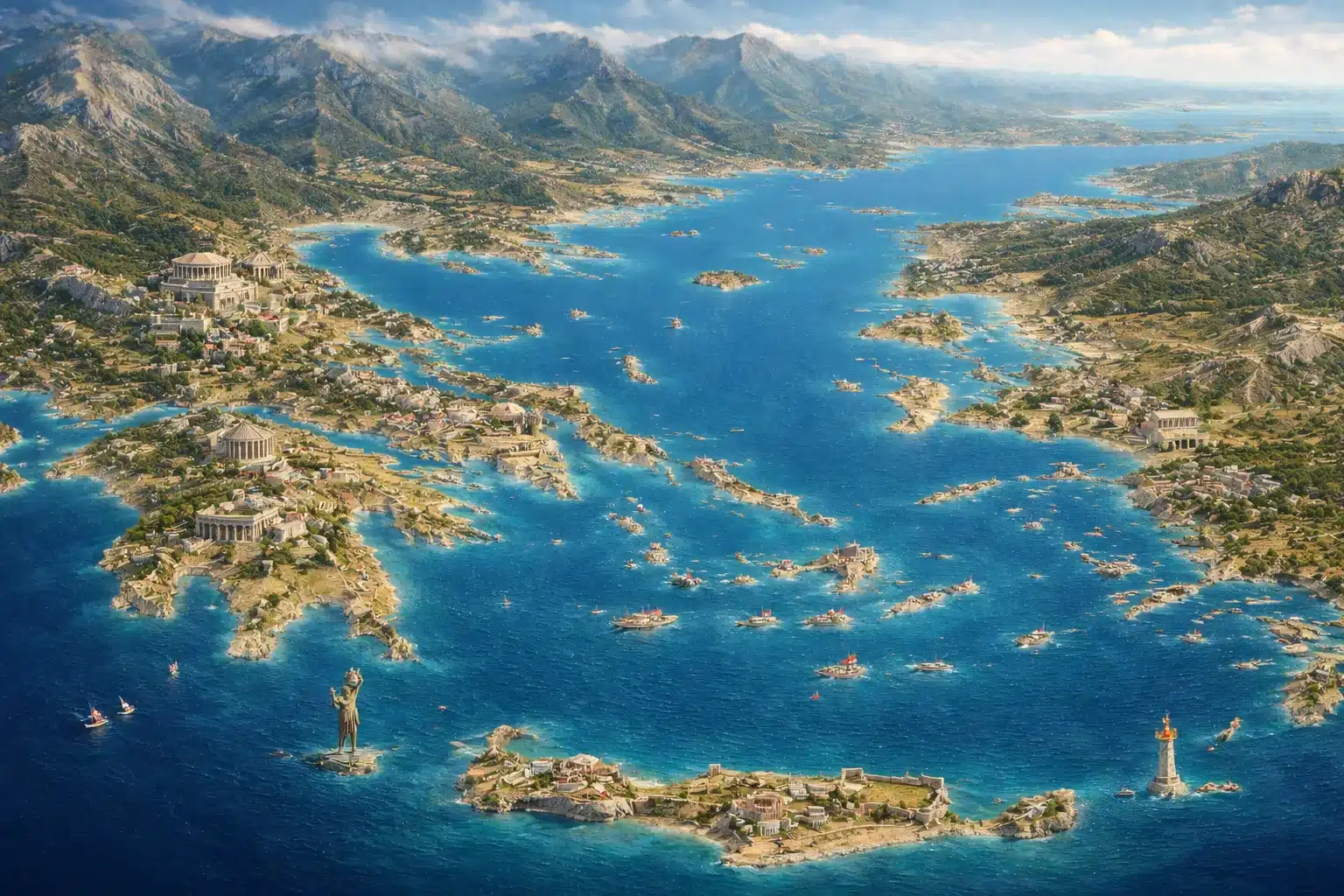
Her geography Ancient Greece She decisively shaped the history, culture and everyday life of her people. Mountain tumors, extensive coastlines and numerous islands created a fragmented but dynamic world of cities-states, with intense naval activity and cultural diversity.
Ancient Greece extended to the southern Balkan peninsula, including its islands Aegean Sea and the coasts of Asia Minor.

🏛️ Periods of Ancient Greece
Ancient Greece extends from 12th century BC up to about 600 C.E.
🔸 End of Mycenaean World
🔸 Coastal damage
🔸 Fall of commercial networks
🔸 Decrease & Writing Population
🔸 Rural economy
🔸 Gradually reappearing cities
🔸 Creation of cities-states
🔸 Colonization
🔸 Develop alphabet & laws
🔸 Akmi Athens & Sparta
🔸 Persian & Peloponnesian War
🔸 Philosophy & Arts
🔸 After Alexander the Great
🔸 Expansion of Greek culture
🔸 Great kingdoms
🔸 Roman rule
🔸 Preservation of Greek education
🔸 Athens as a learning centre
🔸 Capital city in Istanbul
🔸 Establishing Christianity
🔸 Transition to Byzantium
🌍 Geomorphology of Ancient Greece
✅ Development of independent cities-states
Ancient Greek Areas
Ancient Greece was divided into basic geographical units:
- Attica – centered in Athens
- Peloponnese – powerful centers like Sparta and Corinth
- Macedonia – northern Greece
- Thessaly – fertile plains
- Continent – mountain and sparsely populated
- Ionia – Greek cities in Asia Minor
Geographical Characteristics of Ancient Greece
Ancient Greek Mountains
The mountains played an important role in shaping local communities.
- Olympus – the highest mountain, residence of the gods
- Pint – «backbone» of Greece
- Parnassos – connected to the Oracle of Delphi
- Tayget – near Sparta
The mountains made it difficult to move but offered physical protection.
Ancient Greek Seas
The sea was a key element of the life of the ancient Greeks.
- Aegean Sea – main navigation site
- Ionian Sea – west of Greece
- Mediterranean Sea – connection to other cultures
The sea facilitated:
- trade
- colonization
- cultural exchange
Greek Islands
The islands were important centres of culture and commerce.
- Crete – Minoan culture
- Evia – large and strategic island
- Rhodes – mall
- Lesbian – cultural centre
The islands contributed to the spread of Greek culture.
The Climate in Ancient Greece
The climate was Mediterranean:
- Hot, dry summers
- Mild, wet winters
This climate favored:
- agriculture
- outdoor life
- the development of cities
Cities in Ancient Greece
Animals and Crops in Ancient Greece
Animals:
- Goats and sheep (basic livestock)
- Cattle (agriculture)
- Horses (mainly for war use)
- Bees (egg production)
Crops:
- Olives
- Vines
- Wheat and barley
- Figs
Olive and wine were basic products of the economy.
Fascinating Events for Ancient Greece
- Geography led to the creation of independent cities-states
- Greeks became great sailors because of the many islands
- The colonialism was extended throughout the Mediterranean Sea
- The mountains strengthened the local identity of each area
- Natural resources were limited, strengthening trade
Frequently Asked Questions about the Geography of Ancient Greece
Why was the geography of Ancient Greece so important?
Η ορεινή μορφολογία και τα πολλά νησιά διαμόρφωσαν ανεξάρτητες πόλεις-κράτη και επηρέασαν την πολιτική και οικονομική ανάπτυξη.
Ποια ήταν τα βασικά γεωγραφικά χαρακτηριστικά της Αρχαίας Ελλάδας;
Η Αρχαία Ελλάδα χαρακτηριζόταν από ορεινό έδαφος, μικρές πεδιάδες και εκτεταμένη ακτογραμμή με πολλά φυσικά λιμάνια.
Ποια ήταν τα πιο σημαντικά βουνά της Αρχαίας Ελλάδας;
Ο Όλυμπος, η Πίνδος, ο Παρνασσός και ο Ταΰγετος ήταν από τα σημαντικότερα βουνά της αρχαιότητας.
Ποιες θάλασσες επηρέασαν την Αρχαία Ελλάδα;
Το Αιγαίο, το Ιόνιο και η Μεσόγειος Θάλασσα έπαιξαν καθοριστικό ρόλο στο εμπόριο και τη ναυσιπλοΐα.
Ποιος ήταν ο ρόλος των νησιών στην Αρχαία Ελλάδα;
Τα νησιά όπως η Κρήτη, η Ρόδος και η Εύβοια αποτέλεσαν κέντρα εμπορίου, πολιτισμού και στρατηγικής σημασίας.
Πώς ήταν το κλίμα στην Αρχαία Ελλάδα;
Το κλίμα ήταν μεσογειακό, με ζεστά καλοκαίρια και ήπιους χειμώνες, ιδανικό για γεωργία και υπαίθρια ζωή.
Ποιες καλλιέργειες υπήρχαν στην Αρχαία Ελλάδα;
Οι βασικές καλλιέργειες ήταν η ελιά, το αμπέλι, το σιτάρι και το κριθάρι.
Ποιες ήταν οι σημαντικότερες πόλεις της Αρχαίας Ελλάδας;
Η Αθήνα, η Σπάρτη, η Κόρινθος και η Θήβα ήταν από τις πιο ισχυρές και γνωστές πόλεις-κράτη.
Γιατί οι Έλληνες ανέπτυξαν ισχυρή ναυτική δύναμη;
Η γεωγραφία με τα πολλά νησιά και τις ακτές ώθησε τους Έλληνες να στραφούν στη θάλασσα για εμπόριο και επικοινωνία.


