
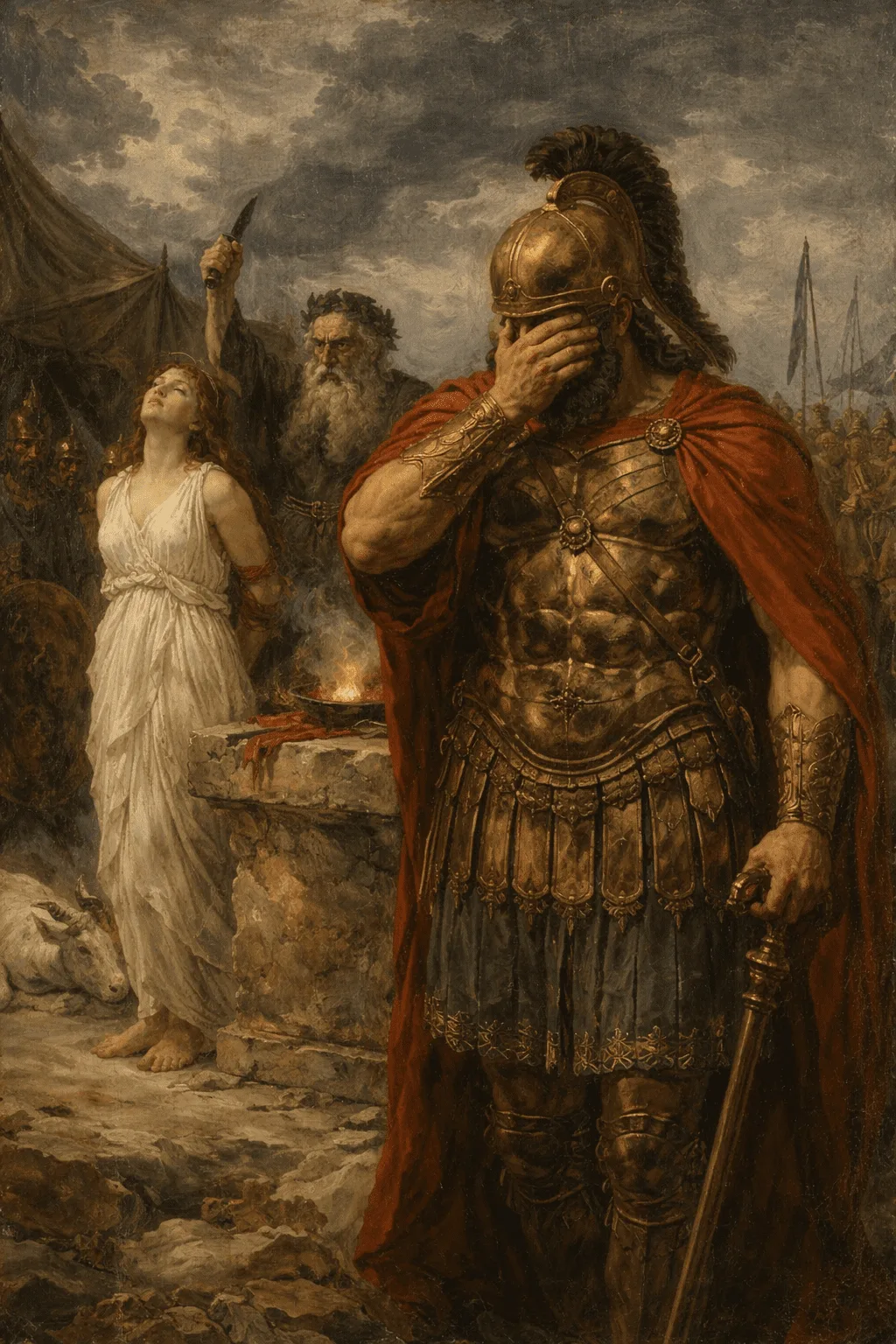
Agamemnon – The King of Mycenae and Leader of the Trojan Campaign
- Agamemnon is one of the most powerful and tragic forms of Greek mythology. King of the Mycenaeans and chief general of the Achaeans in Trojan War, his life is associated with hubris, sacrifice, glory and bloody revenge. His story reflects the curse of the Atreides house and culminates with his murder by his wife Clytemnestra.
Origin and House of Atreides
Agamemnon was his son. Atreas and Air Force and his brother Menelaus. His father had committed a horrible crime against his brother Thyestes, launching a chain of blood that marked the entire generation.
After his exile and return, Agamemnon took over the throne of Mycenae and married Klytemnestra, with whom he had four children:
Iphigenia
Electra
Hrysothemis
Orestes
His Role in the Trojan War
When Menelaus asked for help to recover Beautiful Helen from Troy, Agamemnon took the leadership of the nationwide campaign.
In Iliad of Homer He is presented as a powerful but arrogant leader. Its conflict with Achilles for Vrisida causes a crisis in the Achaean camp and leads to great losses.
The Sacrifice of Iphigenia
Before the fleet left Aulis, apnoea prevented the campaign. The seer Calhas announced that the goddess Artemis He demanded the sacrifice of his daughter, Iphigenia.
Agamemnon was found in front of an extreme dilemma: fatherly love or military duty. According to the prevailing version, Iphigenia leads to the altar, but Artemis replaces it with deer and carries it to Tauris.
This fact seals the hatred of the Clytemnestra and prepares the tragic end of the king.
Return and Murder
After ten years of war and the fall of Troy, Agamemnon returns triumphant to Mycenae, bringing with him as captive Cassandra.
Klytemnestra, in collaboration with Egisthos, murders him inside the palace, avenged the sacrifice of Iphigenia and the insult to her honor.
The murder of Agamemnon later leads to Orestes' revenge and continues the blood cycle of Atreides.
Agamemnon in Ancient Tragedy
Its form was mainly dramatized by Aeschylus in tragedy:
Agamemnon (first part of Orestea)
There he is presented as a tragic king, a prisoner of hubris and fate.
Characterism and Symbolism
Agamemnon symbolizes:
Power and political ambition
The conflict of leadership and morality
The insult to the gods
The inevitable of fate
It is a form that balances between magnificence and tragic fall.
Agamemnon as a symbol of power and tragic fate
Agamemnon is not only one of the most important heroes of Greek mythology, but also one of the most typical examples of how ancient Greeks understood the relationship between power, responsibility and fate. As king of the Mycenaeans and chief general of the campaign against Troy, he was faced with decisions that determined not only his own life but also the fate of the entire Greek world.
His leadership position was not easy. He had to maintain the unity of dozens of kings and rulers, who often differed in their ambitions and interests. Despite his prestige, Agamemnon was not an absolute monarch. He was often forced to consult the board of chiefs and face the reactions of powerful warriors, such as Achilles, Ulysses, Diomedes, and Nestor. This balance between power and cooperation presents an interesting picture of the political organization of the Mycenaean kingdoms, as the ancient poets imagined.
One of the features attributed to Agamemnon is his pride. His clash with Achilles at its beginning Iliad not only does it arise from the claim of Brissida, but it reflects the conflict of two different forms of power. On the one hand is the king, who demands respect because of his position, and on the other the invincible warrior, who considers his personal value to exceed all royal privilege. This controversy leads to serious consequences for the Greek army and is the key axis of the Homeric narrative.
Despite his weaknesses, Agamemnon is also presented as a man who recognizes his mistakes. In several parts of Iliad He admits that his arrogance contributed to the break with Achilles and tries to make amends by offering valuable gifts and seeking reconciliation. This attitude shows that even the strongest rulers are not infallible and that the recognition of error is an element of human nature.
Agamemnon's tragic dimension culminates after Troy's fall. Though he returns victorious and filled with glory, he never enjoys the fruits of his success. His return to Mycenae marks the completion of a curse chain that weighs on the House of Atreides. His wife Klytemnestra, who never forgave the sacrifice of Iphigenia, in collaboration with Egisthos organizes his murder within his own palace.
According to many traditions, Agamemnon is murdered while bathing or during a banquet, without being able to defend himself. His death is presented as an act of vengeance but also as a consequence of arrogance, violence and sins that had accumulated for generations in his house. So victory in the Trojan War does not bring redemption but a new tragedy.
His story continues through his children. His son, Orestes, later returns to Mycenae to avenge the murder of his father, killing his own mother and Aegisthos. This cycle of revenge is one of the most important themes of the ancient Greek tragedy and develops in a unique way in Orestia Aeschylus, where personal revenge is eventually replaced by institutionalised justice.
Agamemnon holds a central position in later literature. Tragic poets are not only interested in his war exploits, but mainly his moral choices and their consequences. His character is presented complex: he is brave and decisive, but at the same time ambitious, proud and often harsh. This complexity makes him one of the most human heroes of Greek mythology.
In modern times, Agamemnon is still the subject of study by historians, philologists, and archaeologists. His name is closely associated with Mycenaean culture, especially after excavations in Mycenae that revealed the impressive royal burial monuments. Although there is no evidence that there has been a real historical person, many researchers consider it possible that his myth was based on the memory of a strong antact of the Late Bronze Age.
Agamemnon's form recalls that power and glory are not enough to ensure happiness. In Greek mythology, even the strongest king remains subdued to fate, the consequences of his actions and the unwritten laws of divine justice. For this reason, Agamemnon is still one of the most timeless and iconic personalities of the ancient Greek mythological world.
Bibliography
Ancient Sources
- Homer. IliadTranslation and comments: D. N. Maronites. Athens: Agra.
- Homer. OdysseyTranslation: D. N. Maronite. Athens: Agra.
- Aeschylus. Orestia (Agamemnon, Hoephorus, Eumenides). Translation: J. N. Gryparis or other modern Greek edition.
- Sophocles. Electra. Athens: Cactus or other valid version.
- Euripide. Electra, Iphigenia in Alidi, Iphigenia in TauridAthens: Cactus.
- Library. Translation and edited by Cactus.
- Tour of Greece. Athens: Cactus.
Modern Studies
- The World of Odysseus. New York: New York Review Books.
- The Greek Myths. London: Penguin Books.
- Early Greece. Harvard University Press.
- The Complete World of Greek Mythology. Thames & Hudson.
- Greek Religion. Harvard University Press.
- Mycenae: Agamemnon’s Capital. Ekdotike Athenon.