
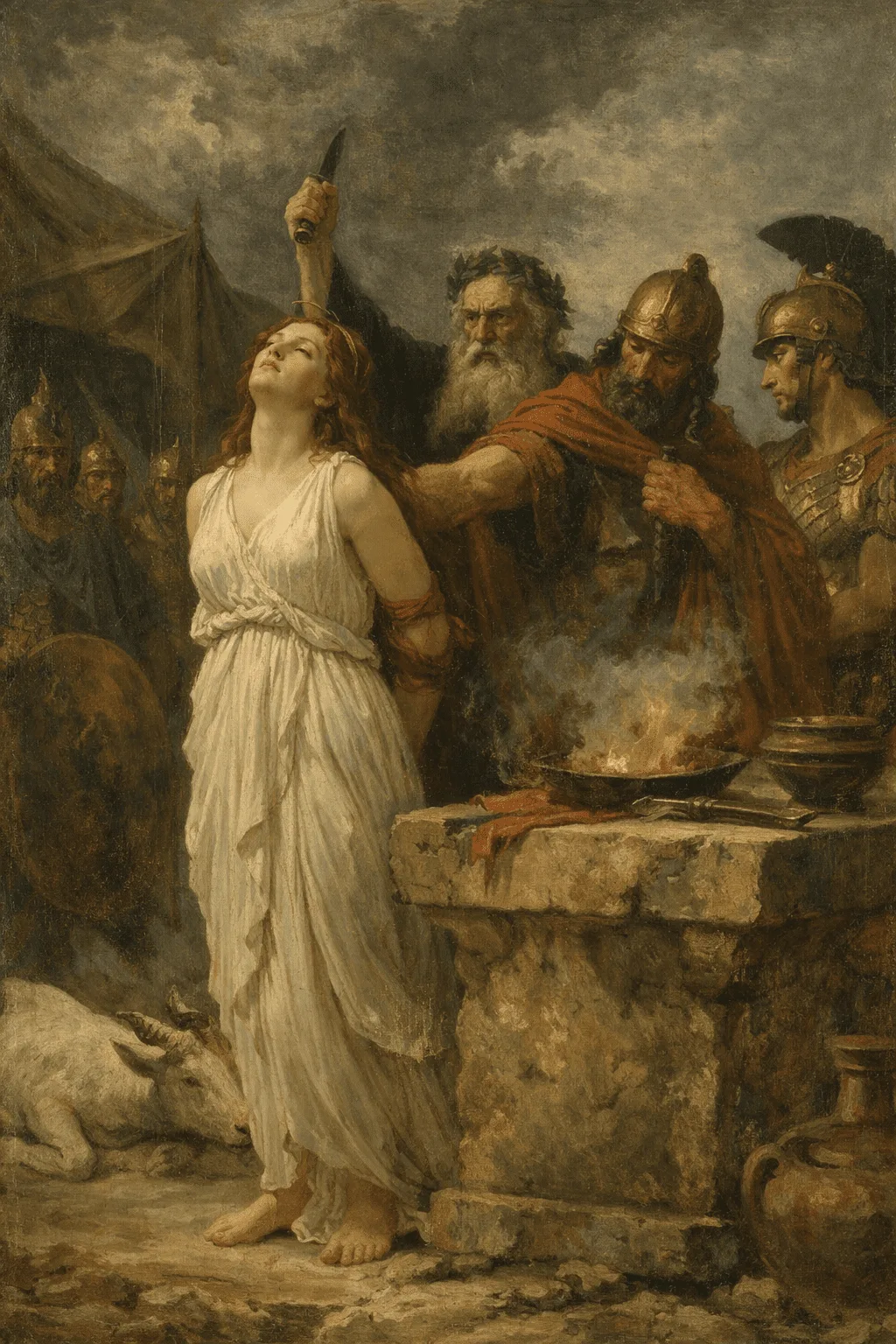
Sacrifice, Artemis, and the Destiny of Atreides
- Iphigenia is one of the most tragic and much discussed forms of ancient Greek mythology. Daughter of the King Agamemnon and Clytemnestra, its history is inextricably linked to Trojan War And with the dark destiny of the Atreides house.
Her sacrifice to Aulis – or her salvation from the goddess Artemis – is one of the most dramatic myths of ancient times and a source of inspiration for tragedies, poetry and philosophical meditation.
«I wish the shepherd had not raised him with the herds, that he had not raised him, Paris, Alexander, to guard his herd next to the crystal springs where the nymphs emerge, and on the rich meadows scattered with roses and hyacinths for the goddesses to collect.»
— Euripides, “Iphigenia in Aulis”
Origin and Family
Iphigenia was his daughter. AgamemnonKing of Mycenae, and Cletemnestra. Her brothers were the Electra, - Hrysothemis and Orestes.
The Atreides house was already cursed by earlier crimes and insults, which also weighs on the fate of Iphigeny.
Sacrifice in the Aulis
Before the campaign against the Troy, the Greek fleet had gathered in Avlid. However, apnea prevented ships from sailing. The seer Calhas revealed that goddess Artemis was angry with Agamemnon and required his daughter's sacrifice.
The reasons for anger differ according to tradition:
Agamemnon had killed Artemis' sacred deer.
He had boasted he was a higher hunter than the goddess.
She had neglected sacrifice in her honor.
Agamemnon, divided between his fatherly duty and military leadership, called Iphigenia to Aulis on the pretext of marriage to him Achilles.
Dilemma and Judgment
In some versions, Iphigeni heroically accepts her fate for the good of Greece. To others, it leads unsuspecting to the altar.
At the time of sacrifice, according to the prevailing tradition, Artemis replaces the girl with a deer and carries her to the bull country.
Iphigenia in Taurid
In the country of the Bulls (now Crimea), Iphigenia becomes the priestess of Artemis and is forced to sacrifice every stranger who arrives there.
Years later, Orestes' brother, pursued by Erinyes, reaches the Tauris along with his friend Pylades. Recognition among the brothers is one of the most touching scenes of ancient drama.
Together they escape, taking with them her sacred cost Artemis, and return to Greece.
Iphigeny in Ancient Tragedy
The myth of Iphigenia was mainly dramatized by Euripide projects:
Iphigenia in Alidi
Iphigenia in Taurid
These projects show:
Agamemnon's moral dilemma
The tragic mother Klytemnestra
Self-sacrifice and the transition from innocence to adulthood
Symbolization of Iphigenia
Iphigenia symbolizes:
The conflict between duty and love
The violence of war that sacrifices innocence
Women's fate in patriarchal society
Atonement through pain
Her myth reflects the price of glory and the cruelty of divine demands.
Alternative Traditions
In some versions:
Iphigenia identifies with the goddess Hecate.
He is worshiped as a deity in the region of Vravron.
Her sacrifice is considered a symbolic ritual transition.
Iphigenia in mythology, religion, and ancient tragedy
Iphigenia is one of the most touching forms of Greek mythology, as its history is associated with the themes of self-sacrifice, family faith, divine intervention and human justice. Daughter of Agamemnon and Klytemnestra, her fate decisively influenced the evolution of the Trojan War and the tragic course of the House of Atreides. Its form inspired poets, philosophers and dramatists for centuries, as through it the boundaries between personal duty and collective responsibility are explored.
According to most traditions, Iphigenia was a young princess who grew up in Mycenae without knowing the fate that awaited her. Ancient sources present her as kind, modest and especially dear to her parents and brothers, Orestes, Electra and Chrysthemi. Her innocence enhances the tragicity of history, as she becomes the innocent victim of a conflict between humans and the gods.
Its sacrifice in Avlid is one of the most important episodes of Greek mythology. However, ancient writers do not all agree on the final outcome of history. In some traditions Iphigenia is truly sacrificed, allowing the Greek fleets to sail for Troy. In others, goddess Artemis is moved by her innocence and, at the last minute, replaces the girl with a sacred deer, carrying her alive to the land of the Bulls.
This second version gained particular importance thanks to Euripides. In Iphigenia in Taurid, the heroine is presented as the priestess of Artemis, forced to serve in a foreign place and participate in ceremonial human sacrifices that she is averted. Her life is characterized by nostalgia for home and a deep desire to see her family again.
The recognition between Iphigenia and her brother Orestes is one of the most touching scenes of ancient drama. Without first knowing each other's identity, they are gradually led to the revelation of their family. Their reunion symbolizes redemption after years of pain and is the beginning of the end of the curse that tormented the House of Atreides.
Iphigenia is also closely associated with Artemis worship. In several areas of ancient Greece there were local traditions that considered the heroine to have gained almost divine status after its rescue. In some sanctuaries they were honored as a priestess or as a heroic figure that was under the special protection of the goddess. These traditions show how mythology and religious worship often influenced each other in the ancient Greek world.
Iphigenia's personality evolves considerably within the tragedies. From a young girl who is led deceived into Aulid, she turns into a mature woman who displays courage, wisdom, and self - control. In Iphigenia in Taurid She uses her intelligence to organize the escape along with Orestes and Pylades, proving that she is not just a passive victim of events but a heroine with initiative and determination.
Its form has been the subject of many interpretations by modern scholars. Some see in its history the reflection of ancient transition rituals from childhood to adulthood, while others see it as symbolizing the conflict between state power and family values. At the same time, her sacrifice is interpreted as a reminder of the high cost that accompanies every major war, even before it begins.
Iphigenia had a huge influence on later European literature. Its history inspired creators such as Rakinas and Goethe, while it was an issue in operas, paintings and sculptures from Renaissance to modern times. Her timeless presence proves that the questions posed by her myth remain topical: what are the limits of sacrifice for the common good, what is the responsibility of power towards the innocent and how reconciliation can be achieved after a cycle of violence.
In the modern study of Greek mythology, Iphigenia is considered one of the most complex female figures. It is not only the daughter who was led to the sacrifice nor only Artemis' priestess. It is a symbol of purity, moral strength and hope, which through her trials manages to overcome pain and contribute to the redemption of her family. For this reason, he continues to thrill readers and scholars, becoming one of the most timeless and iconic heroines of the Greek mythological tradition.
Bibliography
Ancient Sources
- Homer. IliadTranslation and comments: D. N. Maronites. Athens: Agra.
- Euripides. Iphigenia in Alidi. Athens: Cactus or other valid literary publication.
- Euripides. Iphigenia in Taurid. Athens: Cactus or other valid literary publication.
- Shame. Agamemnon (from Orestia). Athens: Cactus.
- Library. Translation and edited by Cactus.
- Tour of Greece. Athens: Cactus.
- Fabulae. Harvard University Press (Loeb Classical Library).
Modern Studies
- The Greek Myths. London: Penguin Books.
- The Complete World of Greek Mythology. Thames & Hudson.
- Greek Religion. Harvard University Press.
- Early Greece. Harvard University Press.
- A Companion to Greek Mythology. Wiley-Blackwell.
- The Cambridge Companion to Greek Mythology. Cambridge University Press.