
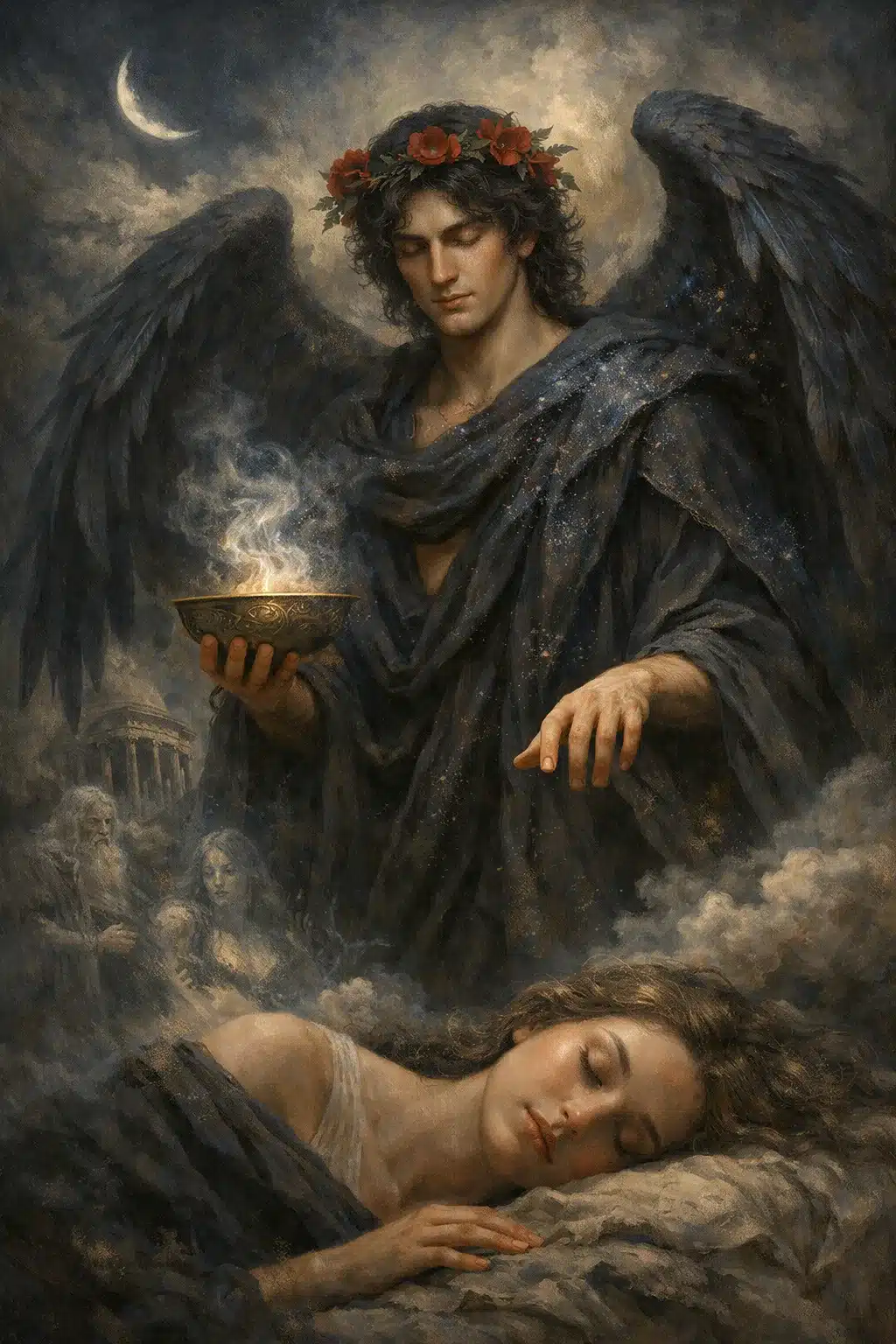
- Morpheus is a god of dreams in Greek mythology, son of Sleep. He appears as a messenger who brings dreams to people, forming images and messages in the night. It symbolizes man's imagination, soul and communication with the subconscious.
The Myth of Morpheus – The God of Dreams in Greek Mythology
Morpheus is one of the most mysterious and poetic forms of Greek mythology. He was not one of the mighty Olympian gods, no warrior, no king. Yet his power was enormous: he could enter people's dreams and shape the very reality of their sleep.
In the world of Greek mythology, where Jupiter's lightning and Neptune's trident dominated, Morpheus ruled something thinner but equally decisive: imagination, illusion and transformation into the dream.
His name comes from the word «Form»And it's not random. It was Morpheus who gave form to dreams.
The Origin of Morpheus
According to the Roman poet Ovid in his work Transformations, Morpheus was his son Hypnos (Somnus in Latin), the god of sleep.
Sleep lived in a dark cave in the depths of the earth, where sunlight never reached. Around him there was absolute silence. There was no sound, no leaf rust. Only the eternal peace of sleep.
Morpheus was not the only son of Sleep. He had brothers, known as Dreams, who also influenced people's dreams. But he stood out because he had the ability to take human form with absolute accuracy.
The Skills of Morpheus
Morpheus could be transformed into any man – king, warrior, friend or relative – and appear in dreams in such a realistic way that the dreamer could not distinguish the illusion from the truth.
The ancients believed that:
Morpheus sent dreams in human forms.
Other Dreams took over animals or inanimate objects.
Dreams could be either divine messages or simple fantasies.
Morpheus acted as a messenger of the gods in the sleep. When a god wanted to warn or guide a mortal without appearing himself, he could send Morpheus.
The Morpheus on «Transformations» of Ovid
The most famous account of Morpheus comes from Ovid. In one of the most shocking episodes of «Transformations», Morpheus is sent by Sleep to convey a message.
The goddess Hera asks Sleep to reveal to Queen Alkyone the death of her husband, Keuka. Sleep chooses Morpheus, for only he can take the form of the dead in such faithfulness.
Morpheus appears in Alkyone's dream in the form of Keukas – pale, wet, ghostly – and reveals the truth to her. When Alkyone wakes up, she realizes that the dream was prophetic.
This scene shows how serious the ancients faced dreams. They were not mere images of the mind, but possible messages from the uncle.
Morpheus’ Relationship to the Underworld
His father, Sleep, was his twin brother Thanatos. This symbolism is deep.
In ancient thought, sleep was considered «small death». During sleep, the soul wandered, liberated from the body. Dreams were the field where the world of the living and the world of the shadows met.
So Morpheus was on the verge of life and death. It belonged not to Olympus, nor Hades, but to the intermediate realm of the unconscious.
The Symbolism of the Morpheus
Morpheus is not just a mythological character. It's a symbol:
The power of imagination
Of transformation
The subconscious truth
The illusion that looks real
In modern psychology, dreams are considered a reflection of the unconscious. Although Morpheus does not appear in scientific theories, his form reminds him of the idea that the mind can create whole worlds.
The Morpheus in Modern Culture
Morpheus' name survives to this day.
The word «morphine» comes from his name because the medicine causes sleep and dreamy situations.
In literature and cinema, Morpheus often appears as a symbol of dream or alternate reality. A typical example is the Morpheus character in the film The Matrix, where it acts as a guide to a hidden truth behind the illusion of the world.
The choice of the name is not random: as the mythological Morpheus shaped dreams, the film character leads the hero to the revelation of reality.
The Morpheus in Ancient Religious Practice
Although there was no widespread worship of Morpheus, dreams were of enormous importance in ancient Greece.
In Asclepieia, believers slept in the sanctuary waiting to have healing dreams from him Asclepius (Aesculapius)Dreams were considered sacred messages.
Morpheus, as personification of the dream in form, embodied this divine intervention in sleep.
Was Morpheus Goodwill?
He does not appear as a malicious god. He does not deceive himself. It acts as an executioner of divine commands or as a physical force of the world.
However, his dreams could cause pain. When it reveals a tragic truth, as in the case of Alcyone, it is no longer a bearer of sorrow.
Morpheus is neither good nor bad. It's inevitable.
The Morpheus and Human Soul
The myth of Morpheus touches a timeless question: what is a dream?
Are they just random images? Are they messages? Is that the voice of the soul?
Ancient Greeks did not completely separate material from spiritual. The dream could be as true as the day experience.
Morpheus personifies this bridge. It is the power that turns immaterial thought into a living experience.
Conclusion
Morpheus is not one of the most famous gods of Greek mythology, but is one of the most poetic and deeply symbolic.
Son of Sleep, messenger of the gods, creator of forms in the darkness of sleep, represents the unseen power of mind.
In a world full of thunder and battles, Morpheus reminds us that the most powerful force may not be violence, but image.
Every time we close our eyes and let the thought create worlds, perhaps somewhere, in the old mythological imagination, Morpheus continues to give form to our dreams.
FAQ – Morpheus
1. Who was Morpheus in Greek mythology?
Morpheus was the god of dreams, responsible for creating human forms within dreams and connected with the world of sleep and imagination.
2. What was Morpheus' mission?
His main mission was to appear in people's dreams taking the form of other people and carrying messages through them.
3. Where does the name Morpheus come from?
The name comes from the word «Form»Because he could take any human form in dreams.
4. What was the role of Morpheus in sleep?
According to legend, Morpheus ruled over the dreams people had when they were sleeping deep.
5. Was Morpheus a god or a demon?
In Greek mythology it is considered a deity associated with sleep and dreams, not a negative or malicious entity.
6. Is there a connection between Morpheus and modern culture?
Yeah. His name is used metaphorically for sleep and has influenced literature, cinema and art.
7. Who were Morpheus' relatives?
The sources of mythology are reported to have belonged to the family of the deities of sleep.
8. Why is Morpheus important in mythology?
Because it symbolizes the power of dreams, imagination and human subconscious experience.
JTNDcCUZRSUwQSVDRSU5MSVDRSVDRSVCQSVDRSVCQSVDRSVCQiVDRiU4RCVDRIU4OCVDRIU4NCVDRSVCNSU4MCVDRSVCNSVDRIU4MSVDRSVCOSVDRIU4MyVDRiU4MyVDRiU4QyVDRIU4NCVDRSVCNSVDRIU4MSVDRSVCNSVDRIU4MiUyMCUzQ2ElMjBocmVmJTNEJTTEYJTJTJTJGA XN0b3JpZXMtbXl0aG9sb2dpYXMmlKYlM0UlQ0UlQjklQ0YlodMlQlQlQlQlQlQlQlQUlQUlQUlQUlQUlQUlQUlQUlQUlQUlQUlQUlQUlQUlQlQlQl0UlQlKYlQlQlQUlQUlQlQlQlQlQlQUlQlQlQUlQlQlQUlQUlQUlQUlQUlQUlQUlQUlQUlQUlQUlQUlQUlQULQULQULQULQULQULQULQULQULQULQULQULQULQULQULQULQULQULQULQULQULQ