
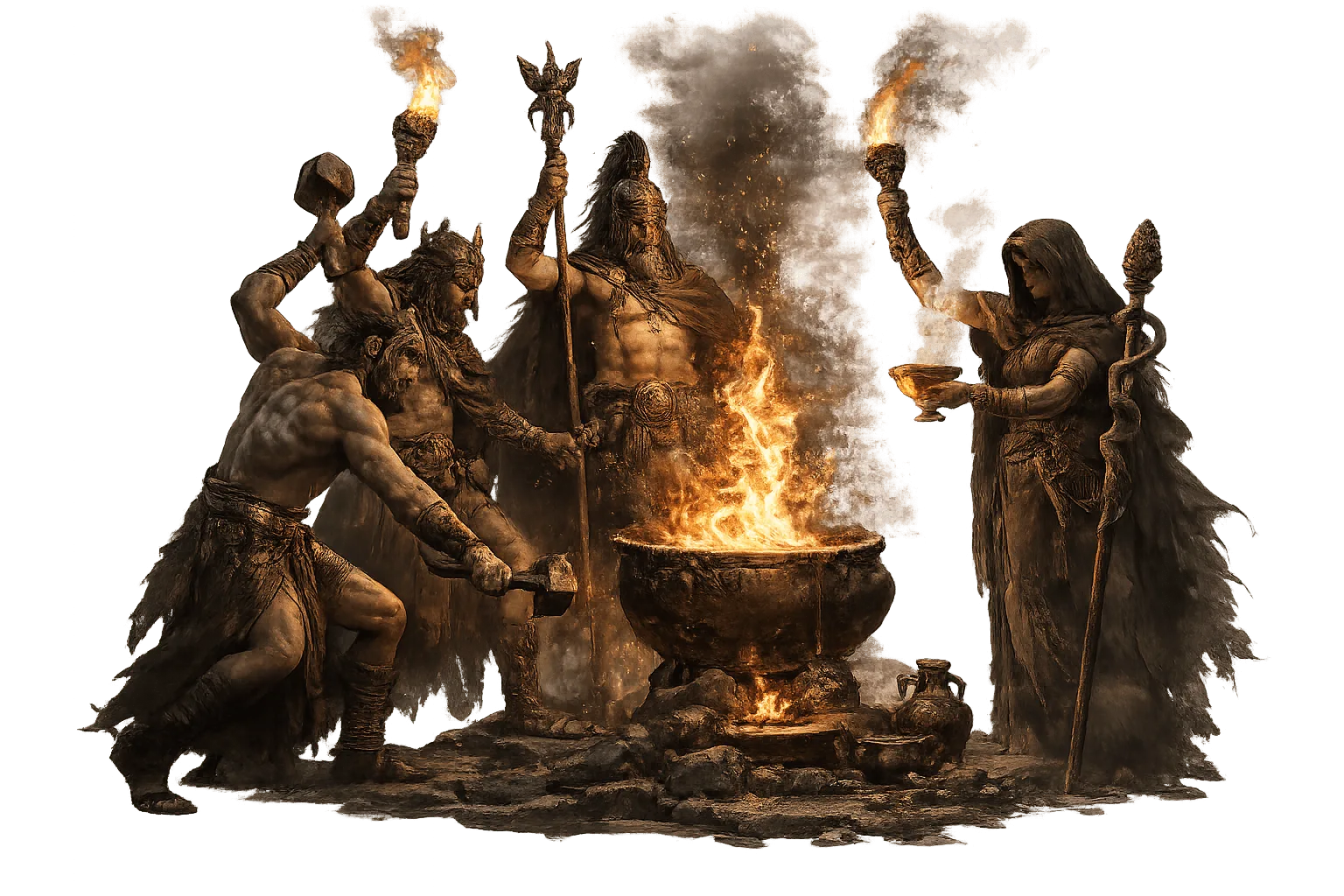
The Cabeirian Mysteries
Mysterious Worship, Chthonia Theology and Salvation Dimension in Ancient Greece
Summary
Cabeirian mysteries are one of the most enigmatic and archaic forms of mysterious worship in the ancient Greek world. Associated mainly with Samothrace, Limnos and Boeotia, these mysteries had a strong ethnonium and salvational character, offering the initiated protection, prosperity and hope of posthumous bliss. This study examines the nature of the Cave Mysteries, their theological basis, ritual practices and their position in the wider context of ancient Greek religion.
1. Introduction
The Cabeirian Mysteries belong to the category of Mysterious cults of antiquity, namely religious practices based on initiation, secrecy and personal religious experience. Unlike the public, state worship of the Olympian gods, the Cave Mysteries operated in one internal, occult level, addressing man's existential anguish towards danger, fate and death.
2. The Cabirians: Theological Identity
The Cabeirs were chthonic deities of vague genealogy and undefined form. Ancient sources sometimes describe them as:
demons of the earth and fire,
deities of fertility and regeneration,
Protectors of navigation and travelers.
This ambiguity is not a lack, but structural element of mysterious theologyAs the concealment of divine identity strengthened the sacred awe and spiritual power of worship.
3. Origins and Historical Roots
The worship of the Cavers is considered:
Pre-Greek, with roots in the Aegean and Asia Minor,
incorporated into the Greek world through cultural assimilation.
Many scholars connect the Cabirians with eastern deities of fire and metallurgy, which explains their close relationship with Hephaestus, especially in Limnos.
4. Geographical Centers of the cabeirian mysteries
4.1 Samothrace – The Sacred of the Great Gods
The most important center of the Cave of Mysteries was Sacred of the Great Gods Samothrace. This sanctuary had:
international,
absence of social exclusions (accepting women, slaves and foreigners),
a strong reputation for salvation and protection, especially for sailors.
4.2 Limnos and Boeotia
In Limnos, the Kavirians were directly associated with Hephaestus, while in Boeotia (especially near Thebes) their worship received local characteristics, with intense fertility symbolism.
5. Character of the cabeirian mysteries
Cave Mysteries had:
a deterrent effect (risk protection) ,
soteriological dimension (favorable posthumous fate) ,
laxative function (removes mixture).
Unlike Eleusinian Mysteries, Caveria did not focus solely on the life-death cycle, but on continuous protection of the initiated within the world.
6. Ritual Practices and Initiation
The exact nature of ceremonies remains unknown due to strict secrecy. However, archaeological and literary testimonies allow certain safe cases.
6.1 Initiation stages
The initiation probably included:
ritual cleansings,
sacred silences and vows,
symbolic events using fire and land.
6.2 Privacy
The unveiling of ceremonies was strictly forbidden. Knowledge was not transmitted through speech but through experience, element characteristic of all mysterious cults.
7. Adult Theology and Symbolism
The enthonic nature of the Kaveiras is associated with:
earth as a womb of life,
fire as a transformation force,
Death as a passage and not an end.
Their ceremonies functioned as symbolic representation of regeneration, both secular and mental.
8. The cabeirian mysteries Mysteries and the Meaning of Salvation
Unlike Christian salvation, salvation in the Cave Mysteries:
was not morally doctrinal,
did not require faith but initiation,
provided practical and existential security.
The salvation was experience and not dogma.
9. Relationship with Other Mysterious Worships
The Cave Mysteries are related to:
The Orphic Mysteries (secretity, salvation),
The Eleusinia Mysteries (quietness and hope after death),
Eastern mysterious cults of fire.
However, they maintain clear autonomy as to their character and function.
10. Conclusions
The Cabeirian Mysteries are one of the most complex and less understandable institutions of ancient Greek religion. Through their secrecy, ethic symbolism and salvational dimension, they express the human need for protection, order and transcendence of mortality. Their importance lies not only in religious practice, but also in their deep philosophical dimension.
Indicative Bibliography
Burkert, W. Ancient Mystery Cults
Cole, S. G. The Samothracian Mysteries
Parker, R. On Greek Religion
Graf, F. & Johnston, S. Ritual Texts for the Afterlife