
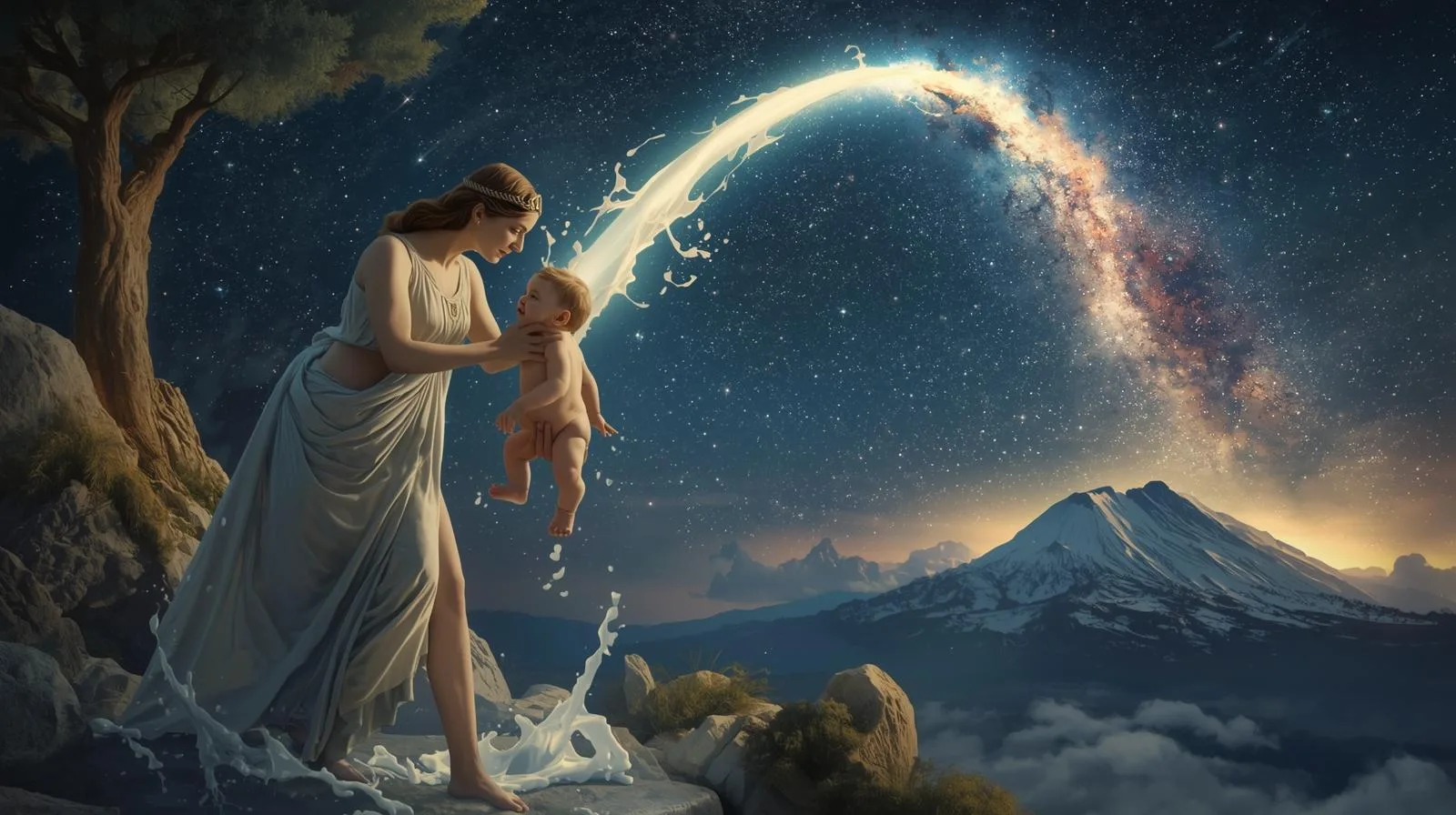
The creation of the Galaxy in Greek mythology
Galaxy is the galaxy in which our planet and our solar system are found. If you look at the sky on a clear night, without light pollution, you will see billions of stars forming a bright zone. In ancient times, the Ancient Greeks called it Galaxy, while the educated Romans Via Lactea, in both cases the name comes from the word «milk».
In Greek mythology there is a story that tells how the Milky Way was created and why it is called this; it is a myth that includes goddess Hera and hero Hercules.
The birth of Hercules in Thebes
The story begins in ThebesWhere Alcmene had become pregnant by God ZeusThe indignant Hera She did everything she could to prevent the birth of her husband's illegitimate son and ordered Ilithyia, the goddess of childbirth, not to allow Alcmene to give birth.
But while Hera was absent, organizing Eurysthea's succession on the throne of the Mycenaeans, Ilithyia was deceived and allowed Alcmene to give birth. Thus, two sons were born in successive days: Alkeidis, the son of Zeus, and Iphicles, the son of Amphitryon.
Alcmene and Amphitryon realized that Hera was angry at them, so Alkeides was renamed Hercules, which means «for the glory of Hera»In an attempt to appease the goddess.
The abandonment of Hercules
Nevertheless, Alcmene and Amphitryon still feared what the angry woman could do Hera as retaliation for Zeus' actions. So, to protect Iphicles, Alcmene made the difficult decision to expose Hercules to a field in Thebes.
The exhibition was an ordinary practice in Ancient Greece to kill unwanted children; if the child died, they thought it was the will of the gods. This explains the many cases of exposure to Greek mythology; however, these children often survived, for it was the will of the gods to live, as in the stories of Oedipus, but also of Amphion and Zethos.
Of course, it was Zeus' will that his son survived, but it was the goddess Athena who intervened for her half brother.
The rescue of Hercules
- Athena observed the abandonment of Hercules in the Tibetan field and, descending from Olympus, took the newborn child and carried it back to Olympus.
Then it seemed Athena's naughty side, as she went to Hera to talk to her about saving this unknown baby — knowing very well which child he had saved.
The Creation of the Galaxy
Hera’s maternal instincts woke up when she saw the infant and, taking it from Athena, began breast - feeding it.
Hercules was breast-feeding with appetite from Hera's nipple, but sucked so hard that the goddess hurt and removed him from her chest. As he did this, Hera's breast milk ejected to heaven, creating the Galaxy.
Hercules was revived by the food he received and Athena returned the infant to Alcmene and Amphitryon. Hercules' parents now realized that it was the gods' will to grow up with them.
Milky Way as a Sacred Phenomenon
In ancient Greek thought, heaven was not just a natural set of stars, but a sacred place full of divine signsGalaxia, the bright white stripe that crosses the night sky, was considered a result. Divine intervention And no accidental cosmic phenomenon.
The word itself Milky Way is derived from milk, element located at the core of the relevant myth.
Hercules and the Divine Milk of Hera
According to the most widespread myth, Milky Way was created by milk of the goddess Hera.
Zeus, desiring to grant immortality to his illegitimate son Hercules, secretly brought him near the sleeping woman Hera to breastfeed from her divine breast.
When Hera woke up and realized what was going on, He pushed the child away.. The milk poured into the sky spread out and formed the light zone we now know as the Milky Way.
Symbolism and Mythological Interpretation
This myth is not just a narrative, but deep symbolic:
Milk symbolizes life and immortality
The sky becomes a carrier divine energy
⚡ The Hera – Zeus conflict reflects the conflict of order and chaos
Hercules emerges as the hero linking mortal and divine world
The Milky Way, like this, becomes visible trace of divine history in the sky.
Ancient Sources and Reports
The myth refers to or implies works of ancient writers such as:
Eratosthenes
Hygiene
Ovid (Transformations)
In Roman tradition, Galaxia is called Via Lactea (Galactic Way), direct translation of the Greek mythological concept.
Myth and Modern Astronomy
While today we know that the Milky Way is a huge stellar formation with billions of stars, the ancient Greeks They used the myth to explain the inexplicable.
Greek mythology does not oppose science· is the first poetic attempt to understand the universe.
The Cultural Heritage of Myth
The myth of the creation of the Galaxy:
Inspired art, angiography and Renaissance paintings
Connects Greek language to international scientific terminology
Keeps the relationship between myth and cosmology alive
✨ Conclusion
For ancient Greeks, Galaxia was not just stars. It was. divine footprintAs a result of a moment of tension between the gods, which eternally illuminates the sky and the imagination of man.