
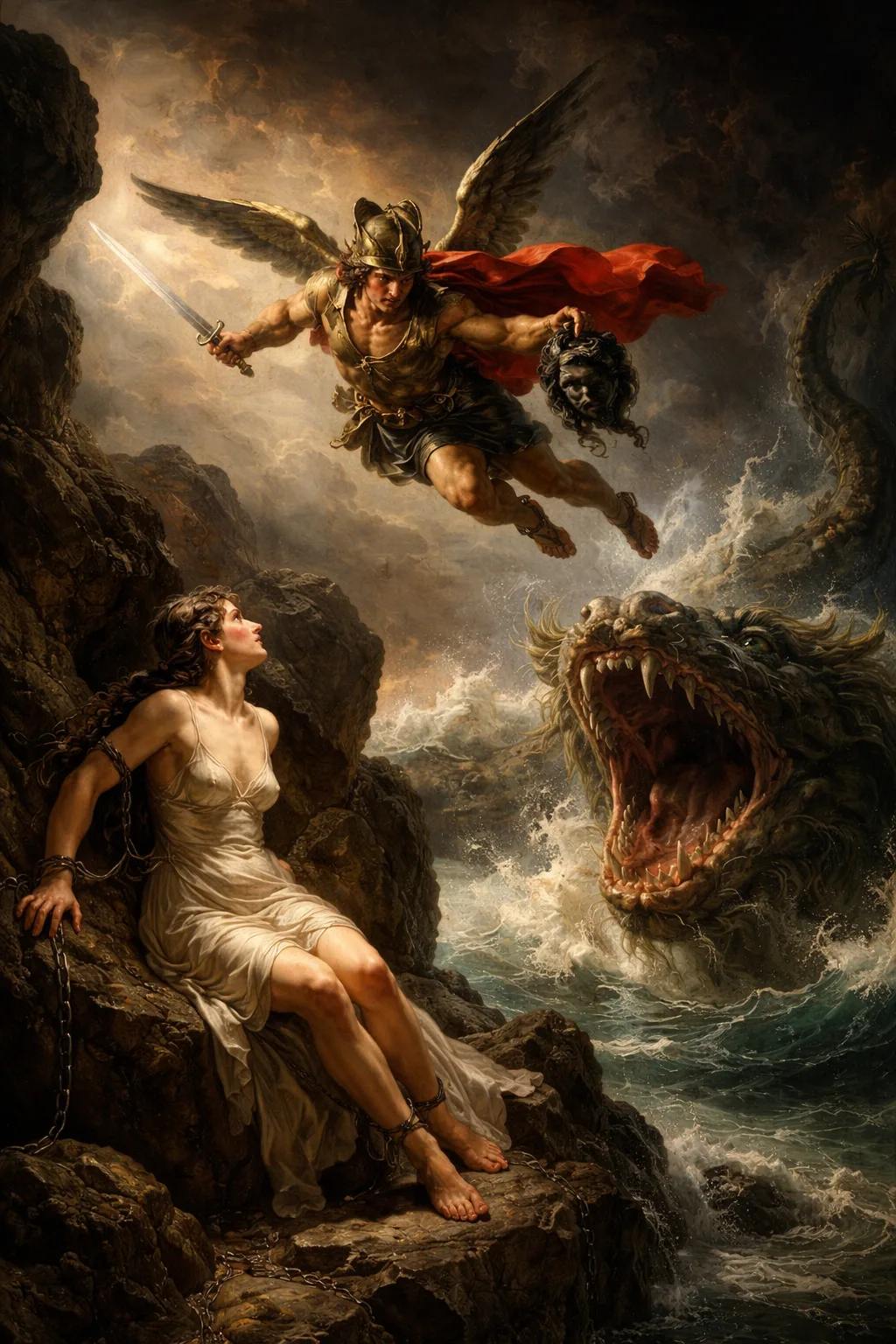
The myth of Perseus and Andromeda is one of the most famous and touching stories of Greek mythology. It combines heroism with tragedy, divine intervention with human hubris, and eventually leads to a union that symbolizes life's victory over death. Through this myth, concepts such as the punishment of gods, the power of fate and salvation through bravery emerge.
Perseus was his son. Zeus and Danae, daughter of King Acricio of Argos. Acrosius, fearing an oracle saying he would be killed by his grandson, imprisoned Danai. However, Zeus managed to approach her transformed into golden rain, and Perseus was born of this union.
The king, trying to avoid his fate, closed Danae and the infant in a crate and threw them into the sea. But they were saved and found on the island of Serifos, where Perseus He grew up and became brave and strong.
The hero's first great act was to eliminate her Medusa, one of the three terrible monsters Mermaids, whose look was petrified by anyone who looked at her. With the help of the gods, Perseus managed to decapitate her, acquiring one of the most powerful weapons of mythology: the head of Medusa.
Andromeda was the daughter of King Kefea and Queen Cassiope of Ethiopia. She was famous for her beauty, but her fate was determined by her mother's arrogance.
Cassiope boasted that she or her daughter were prettier than Nereids, sea nymphs. This insult angered him. Poseidon, who decided to punish the kingdom.
To avenge the insult, Poseidon sent a terrible sea monster to destroy Ethiopia's coast and wipe out the population. The Cepheus, desperate, asked for an oracle about how the kingdom will be saved.
The answer was harsh: only if Andromeda sacrificed to the monster, would the disaster stop. Thus, despite their grief, her parents decided to chain her to a rock by the sea, waiting for her tragic fate.
While Andromeda was tied to the rock, Perseus appeared, returning from his mission with Medusa. Facing the young girl, she was moved by her beauty and misery.
Learning her story, Perseus offered to save her in exchange for her hand in marriage. Her parents agreed, and the hero prepared to face the monster.
When the monster emerged from the sea, Perseus entered the battle. In some versions of the myth, he kills it with his sword, while in others he uses her head Medusa to turn it into a stone.
His victory was impressive and saved not only Andromeda but also the entire kingdom from destruction.
After her salvation, Perseus and Andromeda married. However, their happiness did not come without obstacles. A former Andromeda suitor, Phineas, tried to claim it, leading to conflict.
Perseus, to defeat his opponents, again used Medusa's head, turning them into stone.
Return and fate
Perseus returned with his wife to Greece, where he unwittingly fulfilled the oracle by killing his grandfather Acricio during games.
Despite this tragic development, Perseus became king and founded important cities, while Andromeda stood by him as a loyal companion.
The myth in constellations
After their death, the gods honored Perseus and Andromeda by placing them in heaven as constellations. With them are the forms of Cassiope and Kefea, creating an entire mythological complex in the night sky.
Symbolism of the Myth
The myth of Perseus and Andromeda has a deep symbolic character:
- Cassiopeia's hubris represents human arrogance towards the gods.
- Andromeda’s sacrifice shows the injustice that may result from others ’ mistakes.
- Perseus symbolizes the hero who intervenes to restore balance.
- Salvation and marriage express the victory of life, love, and justice.
The Myth of Perseus and Andromeda: Analysis
Some mythology stories are not just adventures. They're mirrors of the human soul. The myth of Perseus and Andromeda combines all the elements we love: a brave hero, a beautiful princess in danger, a scary sea monster and, of course, a victory that seems to surpass even fate. It's the classic story of «hero who saves the daughter», but beneath the surface hides much deeper lessons about courage, identity and our ability to deal with monsters – externally and internally.
The birth and accomplishment of Perseus
Perseus is born to Zeus and Danae, the daughter of King Accusius of Argos. Acrosius, frightened by an oracle that said his grandson would kill him, shuts Danae into a bronze chamber. But Zeus enters as a golden rain and Danae becomes pregnant. Mother and son are thrown into the sea in a wooden box, but they are saved and reach Serifos.
There, Perseus grows. When the king Polydector wants to send the young man away to marry his mother, he assigns him an impossible mission: to bring the head of Medusa, the most terrible of the Mermaids. Anyone who looked her in the eye would be petrified immediately.
With the help of the gods – particularly Athena and Mercury – Perseus is equipped with magical objects: feathered sandals, Hades' helmet that made him invisible, a bag and a diamond sickle. Following the advice of the Elders, she reaches the nymphs, takes his tools and decapitates Medusa by looking at her reflection on a shield. From her neck are born Pegasus and Chrysaor.
Flying over the sea with feathered sandals, Perseus arrives in Ethiopia (or in the Phoenix area according to other versions), where he faces a horrible sight.
Andromeda and the Beast
Andromeda, daughter of King Kefea and Queen Cassiope, pays the price of maternal pride. Cassiope had boasted that her daughter was prettier than the Nireides. Angry Neptune sent a huge sea monster, Cetus, to destroy the coast. The oracle said only the sacrifice of Andromeda would save the kingdom.
Tied to a rock by the sea, Andromeda awaits death. Perseus sees her and falls in love instantly. He promises Kefea to kill the monster in exchange for marriage to his daughter. With the help of the head of Medusa and his sword, he defeats Keatus. He saves Andromeda, they marry and together they return to Greece. Later, Perseus unwittingly fulfills the old oracle, accidentally killing his grandfather Acricio in games.
Symbolism and philosophical dimension
The myth of Perseus is his epitome a heroic journeyPerseus is not born a hero.· It's done. He faces fate (the oracle), transcends obstacles, uses intelligence and divine help, but mainly shows courage and determination.
Andromeda symbolizes the innocence sacrificed for the mistakes of the older, but also the passive beauty waiting to be saved. On a deeper level, Cetus represents the chaos of nature and the repelled monsters of the unconscious. Perseus, cutting Medusa's head off and using it as a weapon, shows how we turn our own monsters into power.
The myth is talking about human ability to change fate. Although the oracles seem irrevocable, Perseus treats them with action and love. The salvation of Andromeda is not only romantic· is an act of freedom against the blind punishment of the gods.
In modern culture
History has inspired countless works. The classic film «Clash of the Titans» (1981) and the 2010 remake made it known to new generations. In literature, painting (see paintings by Rubens, Ingres) and opera, the image of Andromeda tied to the rock is iconic.
Today, history is often examined through a feminist perspective. Andromeda is no longer just «The princess who is saved»Modern covers present it more active, with its own voice and power. At the same time, Perseus remains a model superhero: the man who uses his gifts (talents, opportunities, help) for the common good.
In psychology, myth is used to describe our need to «Save» Someone, but also the risk of seeing the other only as a victim. In the astronomical sky, the stars Perseus, Andromeda and Cetus remind us that the myth is written even in the stars.
Why does legend survive?
Perseus and Andromeda survive because they touch archetypes that do not lose their power: fear of the unknown monster, yearning for salvation, hope that love and courage can defeat chaos. In times of crisis – whether personal or collective – we need stories where a man (or a woman) gets up and says «No» The monster.
It's not just the victory that moves us. It is the idea that even when we are tied to a rock and the wave rises, someone – or something inside us – may appear to cut the shackles. And that monsters, no matter how scary, can be defeated.
Perseus is not perfect. But he's determined. And that makes him a timeless model: it reminds us that heroic action is not the absence of fear, but the ability to act even though we are afraid. And that sometimes, the biggest victory is to save someone else – or ourselves – from the rock.