
Temple of Olympian Zeus: The Greatest Sanctuary of Zeus in Ancient Athens
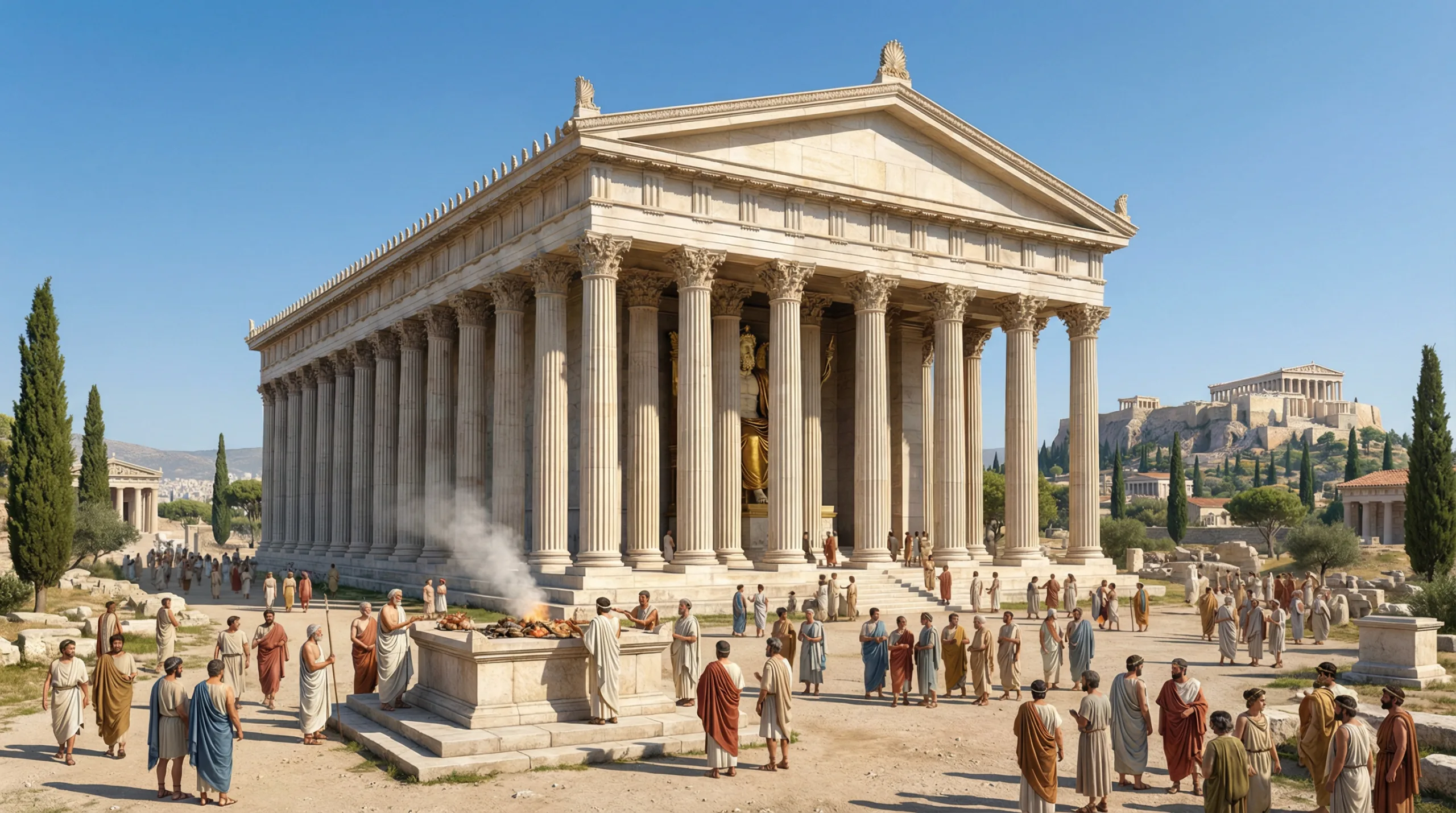
- Temple of Olympian Zeus, also known as Olympian, has been one of the most ambitious and impressive building projects of antiquity. Dedicated to the Supreme God ZeusThis temple has been a symbol of power, political ambition and religious worship for centuries. Its construction began in the archaic era, but was completed after nearly seven centuries, in the Roman period.
Today his imposing ruins, just steps from the Acropolis of Athens, recall the greatness of ancient religious architecture and the evolution of its city Athens Through the centuries.
The establishment of the sanctuary and the first plans
The history of the temple begins in the 6th century BC, when the tyrant of Athens Convinced. and his sons decided to create the largest temple dedicated to Zeus in the Greek world.
The plan was ambitious: a colossal temple that would surpass all other Greek temples and symbolize the power of Athens.
The original architects, probably from Miletus, they designed a giant double stand doric templeWith hundreds of columns. However, the work was stopped after the fall of tyranny, as the Athenians considered the monument a symbol of authoritarian power.
For nearly four centuries, the structure has been unfinished.
Restart construction
The next significant effort to complete the temple was made in the 2nd century BC by the king Antiochus IV Prominent, ruler of the Hellenistic kingdom of Seleucids.
Antiochus hired the Roman architect Decimus Cossutius, which redesigned the temple at Corinthian rate — An architectural guy who was considered more luxurious and magnificent.
Despite new work, the death of Antiochus in 164 BC again led to the interruption of construction.
Completion in Roman times
The temple was finally completed in the 2nd century AD by the Roman emperor Hadrian, a ruler known for his love of Greek culture.
During this period:
completed construction of the huge temple
placed giant statue of Jupiter
a new sacred complex was created around the temple
Hadrian also dedicated a statue of himself beside Zeus, suggesting divine favor to the emperor.
Architecture and dimensions
The Temple of Olympian Zeus was one of the largest temples of antiquity.
Key characteristics
Length: approx. 110 metres
Width: approx. 44 metres
Key height: approx. 17 metres
Total columns: 104 Corinthian columns
Today they are saved 15 columns, while another is lying on the ground by a storm that occurred in 1852.
Corinthian columns are one of the best preserved examples of this rhythm in the ancient world.
The statue of Zeus
The statue of Zeus
Inside the temple was a huge cult statue of Zeus, probably of gold and ivory.
A statue of the emperor was placed next to him. Hadrian, creating a symbolic link between divine and imperial power.
Religious worship and rituals
The temple was not just an architectural miracle. It was also a center of important religious rites in honor of Zeus.
Sacrifices
The sacrifices to Zeus included:
cattle sacrifices
wine offers
burn incense
ritual processions
The ceremonies were held in altar outside the temple, as the ancient Greek temples did not function as gathering places of believers, but as dwellings of the gods.
Celebrations in honor of Zeus
At Olympian there were probably celebrations dedicated to Zeus, with:
music games
sports displays
public sacrifices
Worship was associated with royal and imperial power, especially in the Roman period.
Olympian and the city of Athens
During Hadrian's time, the temple joined a wider building program that changed the image of Athens.
The emperor also created:
The Library of Hadrian
The Hadrian Gate
The gate even symbolically marked the passage from «Old town of Theseus» THE «new city of Hadrian».
Decline and destruction
With the spread of Christianity in the 4th century AD, ancient cults began to be abandoned.
Jupiter's sanctuary gradually:
looted
used as a source of building materials
abandoned
In the following centuries, many columns collapsed from earthquakes or storms.
The temple today
Today the Temple of Olympian Zeus is one of the most impressive archaeological monuments of Athens.
Its imposing Corinthian columns create one of the most recognizable landscapes of the ancient city and are a key point of interest for visitors from around the world.
The monument is part of the wider archaeological site protected by the Greek state and attracts millions of visitors every year.
Conclusion
- Temple of Olympian Zeus It's not just an ancient monument. It is a work that captures:
the political history of Athens
the evolution of architecture
the religious cult towards him Zeus
and the transition from Greek to Roman world.
Since his time Pesistratus until completed by Hadrian, Olympian remains one of the most impressive symbols of ancient history Athens and the timeless power of the Greek heritage.
JTNDc2VjdGlvbiUyMGNSYXNzJTNEJTiyaW50ZXJuYWwtbGlua3MlMjlMjBzdHlsZSuzRCUyMhJhY2tncm91bmQtY29sb3IlM0lMjJNM0lMjBwYWRkaW5nJTNBMjBweUzQiUyMJvcmRlci1yWrpdXMlM0ExMB4JTNCJTJOYM94LXNOYWRVDYUZTALMJAyMJAyKJHLJGLJGLYJHLJJJJJJJJDJDJDJDJDJTJTYJTJJTJTJTJTJTJTJTJTJTJTJTJTJTJTJTJTJTJTJTJTJTJTJTJTJT Ny UyQyUyjjjjjjjjjjjjjjjjjjjjjjjjjjjjjjjjjjjjjjjjjjjjjjjjjjjjjjjjjjjjjjjjjjjjjjjjjjjjjjjjjjjjjjjjjjjjjjjjjjjjjjjjjjjjjjjjjjjjjjjjjjjjjjjjjjjjjjjjjjjjjjjjjjjjjjjjjjjjjjjjjjjjjjjjjjjjjjjjjjjjjjjjjjjjjjjjjjjjjjjjjjjjjjjjjjjjjjjjjjjjjjjjjjjjjjjjjjjjjjjjjjjjjjjjjj